
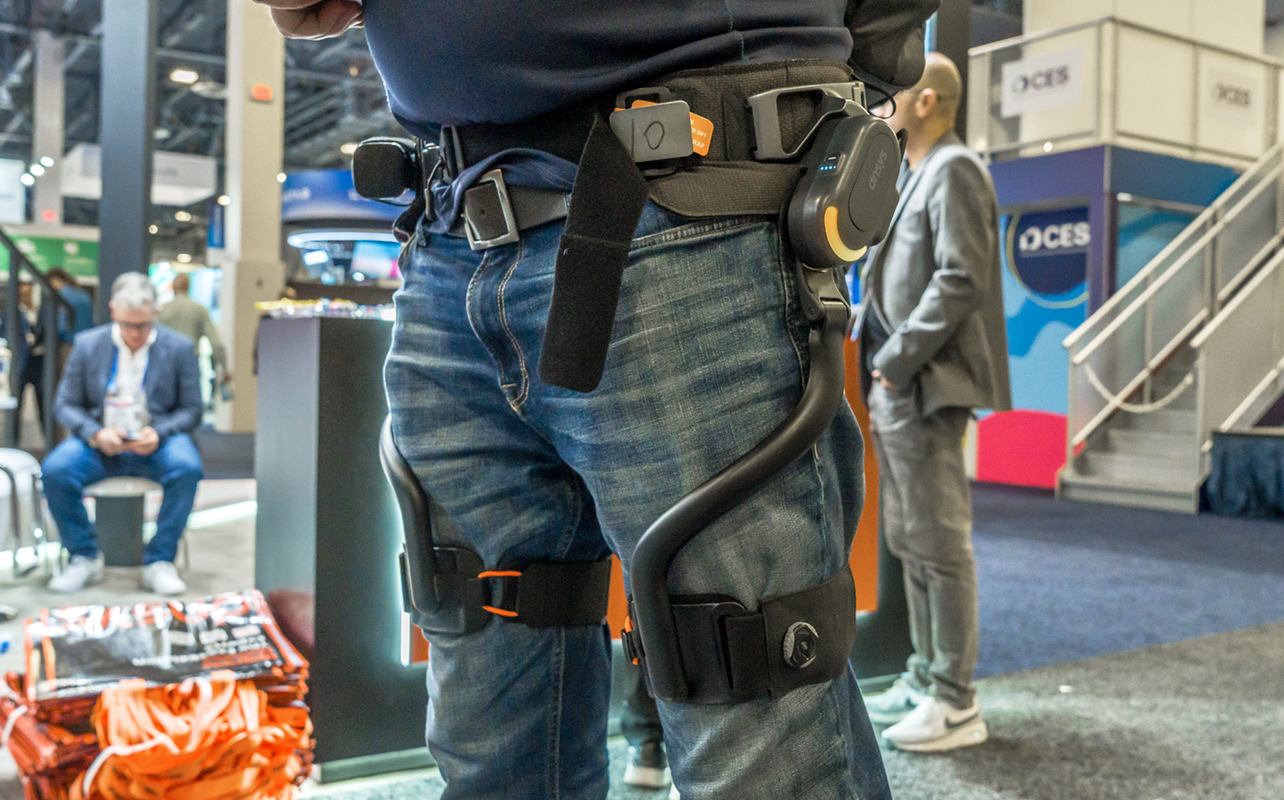
If you can get an extra lift from an exoskeleton, would you consider wearing one to help restore some physical movement? That’s the promise of exoskeletons, wearable devices that serve to make it easier to move around or traverse terrain that may prove more difficult due to age or injury.
To be clear, we’re not talking about reversing disability here. These aren’t miracle products that can lift someone out of a wheelchair and turn them into spry teenagers. Exoskeletons also come in various forms, as evidenced by what vendors showcased at CES 2026 in Las Vegas. In the simplest terms, they are wearable harnesses or suits that fit over your limbs and torso with built-in hydraulics and motors. Once activated, they can help take pressure and weight off the legs and hips to enable more movement with less effort.
While I saw several of these at the show, I got to wear one—the Dnsys X1—for a couple hours working the show floor (while carrying a heavy load in my backpack) to gauge the feeling of using one. This was one of my standout picks at CES, and here are details on what this interesting technology could deliver.


What makes up an exoskeleton?
The term “exoskeleton” infers that it’s a hard shell or full-body suit, like something out of a sci-fi movie, but the application here is considerably different. What you have in this case is high-tech hardware using a mix of motors, springs, or cables to augment human strength and endurance. The key word there is “augment”; it helps rather than replace what a human can do.
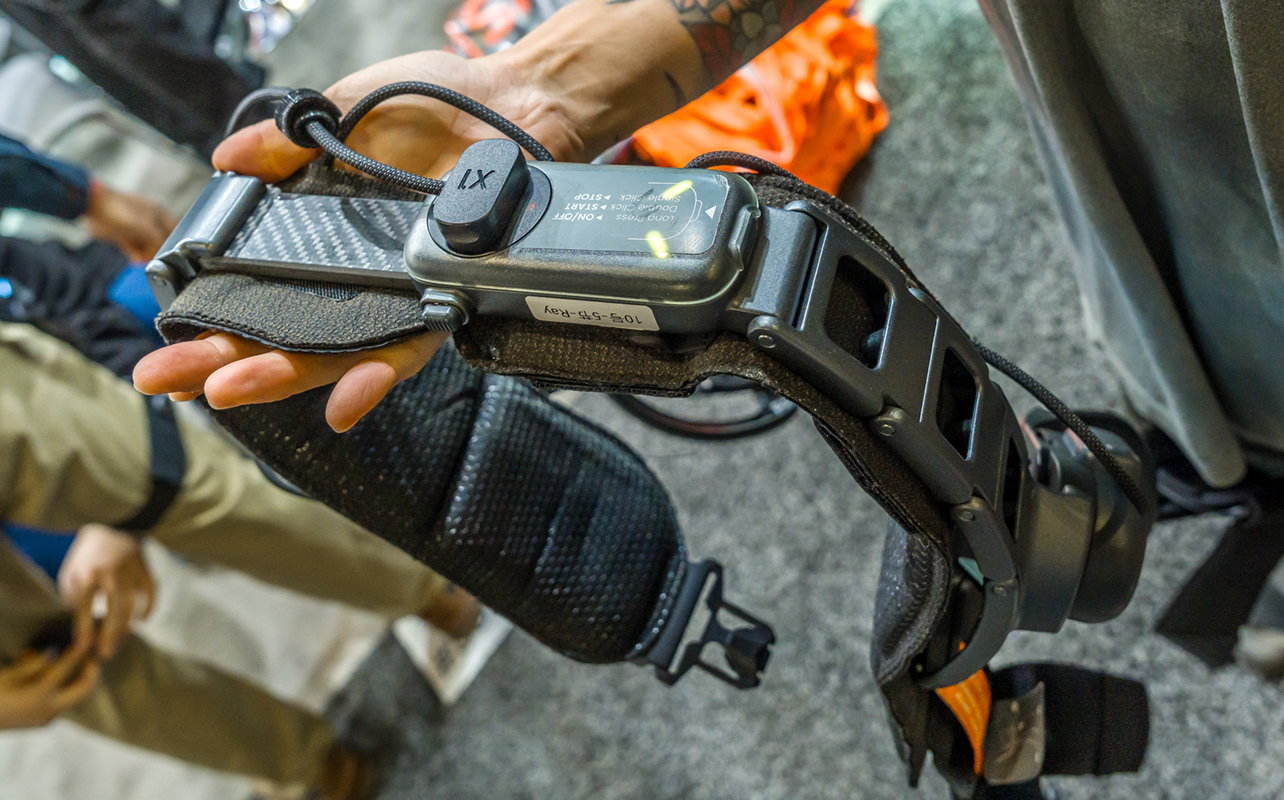
CES indicated that we’ve moved past the phase where such things were made for lab or military purposes. For so long, these devices were bulky, heavy, and limited in battery capacity. They just weren’t practical for civilian use outside of very specialized cases.
Now that companies like Dnsys, Hypershell, Ascentiz, and WIRobotics, among others, demo their products as ready-for-consumer devices, the advances in this area are hard to ignore. Lighter weight, better battery life, and increasingly sleeker, they are beginning to move from industrial designs to lifestyle purposes. It was one of the more interesting shifts I personally saw at the show.
A big reason why is because the technology addresses physical limitation as a universal human challenge. Senior citizens can wear a lightweight exoskeleton like the Dnsys X1 to get the necessary “push” to climb stairs or walk through a park without joint pain. Not only can that extend their independence, but increased confidence might be incalculable for someone previously resigned to sitting down.
Those working physically demanding jobs in construction or warehousing might see enormous benefit wearing an exoskeleton as a preventive tool. If it can absorb the strain of heavy lifting and repetitive motions, it might mitigate chronic back injuries and long-term disability typically associated with those roles.
What it’s like to wear an exoskeleton
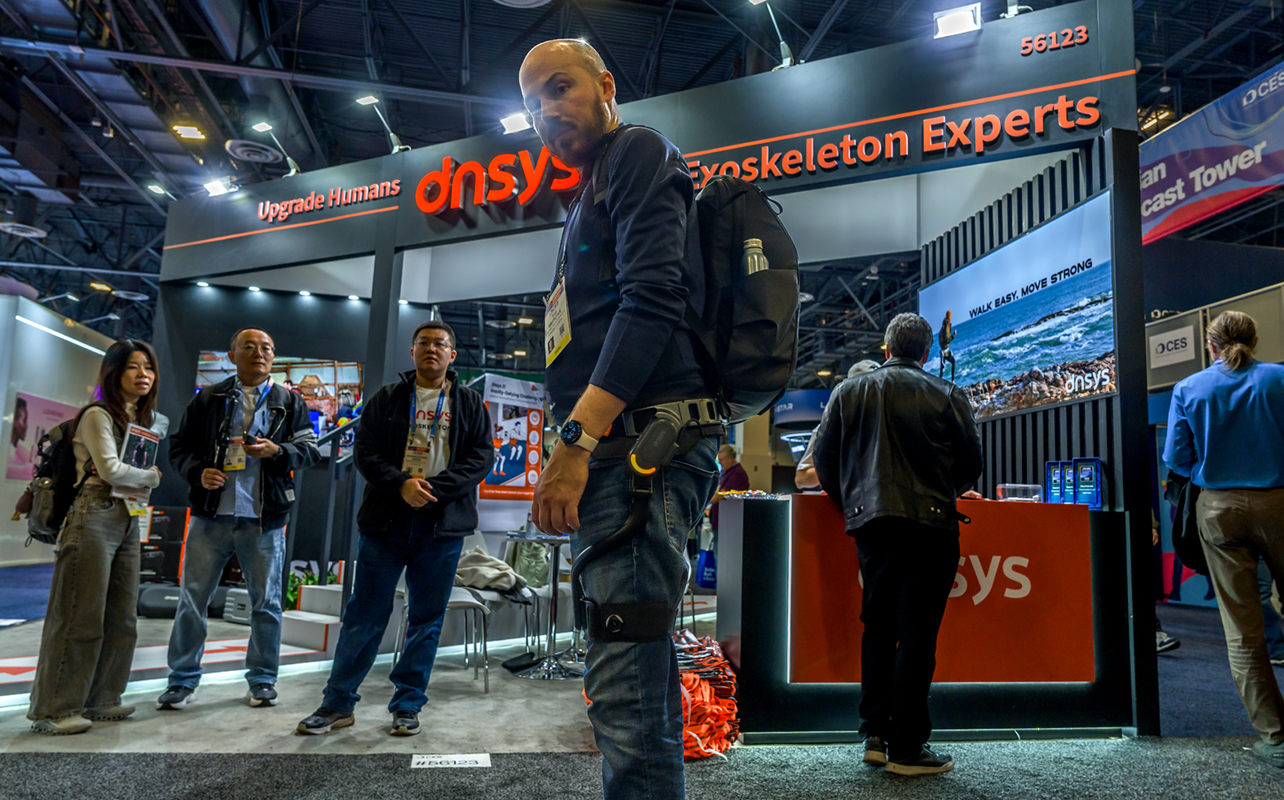
I’m not in construction and don’t work in a warehouse but working CES as a journalist and photographer is a grind unto itself. Lugging around the gear necessary to do the job and trying to cover a lot of ground on foot is the prime logistical challenge. Prior to CES, I arranged with Dnsys to wear an X1 on Day 2 of the show to try it out.
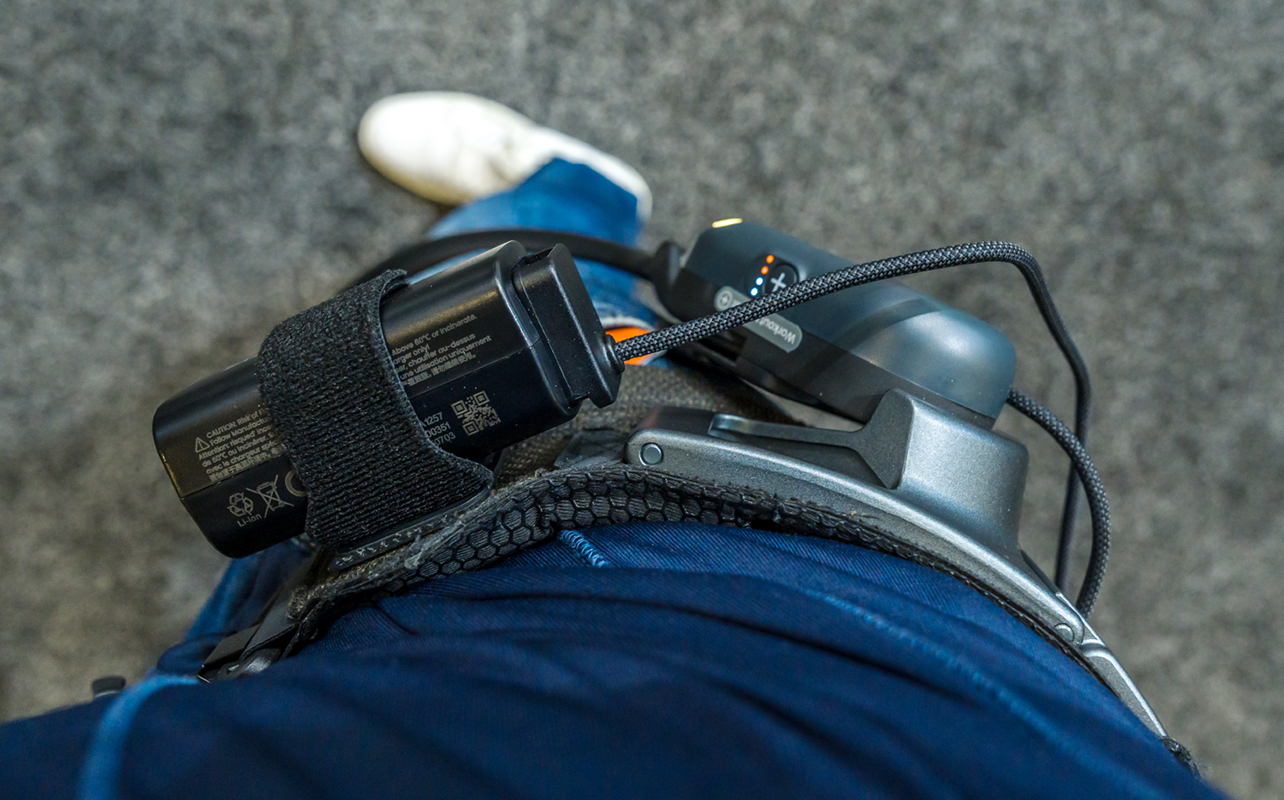
I had help but it’s not the type of device that’s hard to put on. Essentially, there’s a belt-like fastener over the torso with clips that wrap around the thighs. Batteries on both sides power the onboard motors, with LEDs indicating the power level for the high-torque motor. It has a peak output of 900W, so about 1.2 horsepower, which is why there are adjustable levels.
Transparent Mode is neutral in that it offsets the device’s weight to make it feel like you’re not wearing it. Not bad considering it weighs 3.53 lbs. (1.6 kg). Eco Mode activates the motors slightly for a light effect that is more ideal for flatter terrain and casual strolls. Sport Mode increases the torque to boost the effect when there’s a faster pace or steeper hills and hiking terrain. Boost Mode is a battery-drainer, but it’s a turbo setting kicking in 1.2 horsepower for high-speed bursts and steep inclines. If you wanted a setting to help you run, this would be it.
I tried them all at different intervals to gauge the difference. The best way I can describe it is like something lifting my legs without dismounting my feet. Each step feels more “airy” in that my joints aren’t working as much to take each step. Mind you, the exoskeleton does nothing for already sore feet or ankles, though the impact of each step feels lighter because of the motors.
Dnsys says the modes reduce muscle fatigue by up to 45% in the thighs, leading to a lower heart rate simply by providing a motorized “push” to your hip joints. I can’t quantify the percentage but I can say there’s less effort in moving over a longer distance. I suspect that without carrying a heavy backpack at the same time, the effect might’ve felt even more substantial.
Practicality and predictability
I turned more than several heads at the show wearing the X1. A few asked me what it felt like wearing it. The genuine interest also came from those who knew someone they thought would benefit from a device like it. With an aging population, the very idea of motorized augmentation makes sense to keep people mobile for longer.
Expect AI to play a role in this, too. The X1 also features an AI-powered adaptive mode Dnsys calls a “Copilot” that tracks gait 1,000 times per second. It can tell whether you’re about to take a step, climb stairs, or stand up.
A dual-core processor and embedded sensors take the data in real time and automatically scales power output between the various levels based on walking rhythm and terrain it detects. The key is that neural networks inside aim to detect these things before you take each step. So, while changes may be subtle in some instances, they can become significant when your body or terrain demands it. Other brands making exoskeletons are doing the same to find ways to utilize AI to make adjustments on the fly. The thinking is that this is also a safety precaution to help avoid accidents.
Everyone has a walking style. AI that “learns” that style can adjust the exoskeleton to map the rhythm and stride length, thereby reducing the time it takes for the device to adapt to each step. The Hypershell X promises this exact functional form.
What about travel?
Exoskeletons are getting small enough now where they fold up into carrying cases. Since they often run on lithium batteries, you can’t check it into a suitcase, but you can take it as a carry-on or personal item. Travel regulations suggest you keep it at roughly 30-50% charge, though a full charge is perfectly acceptable—if not preferable. More than likely, you would need to unzip the case and run it through the machine at airport security.
The main thing is there is not much to stand in the way of travelling with one. If you need to wear it during a layover, for example, that’s totally fine. It just may not be comfortable doing so during a flight simply because it can feel bulky in the seat. Nor does it serve much of a purpose while sitting down for long periods.
Physical AI and active assistance
Exoskeletons may usher in one of the biggest shifts in wearable tech we’ve seen in over a decade. We are long past the era where wearables entered new territory in tracking steps and heart rate or acting as an active motivator. This kind of technology is less about monitoring your health and more about intervening to improve it.
More importantly, wearing an exoskeleton isn’t an excuse to be lazy. Quite the opposite, actually. Consumer exoskeletons, like the X1 and others, are built to assist and augment, so muscles still need to work. It’s just helping remove the strain that may have negated users to walk further and more frequently.
Years after concepts and prototypes proposed that motorized gizmos could help humans do more, exoskeletons are finally arriving as mobility enhancers. Not niche medical equipment or prohibitively expensive experiments, but rather devices that may redefine what a “power suit” could mean.
Check out all the latest health and fitness tech available now at Best Buy.




This one got my attention because I’m trying to understand which exoskeleton coverage is actually useful and which is just CES excitement. Yours felt more useful because you had actual wear time with the Dnsys X1 and described the category in a pretty down-to-earth way. I also liked the point that we’ve moved beyond the stage where these things were only lab or military curiosities, even if that doesn’t automatically mean they’re ready for everyone. After reading, I looked up this explainer here: https://www.exoskelette.com/wissenswertes/wie-funktioniert-ein-exoskelett/ and what I found there helpful was a more practical explanation of how support and movement assistance are supposed to work. From your own experience, what felt most “real” about the device, and what still felt like early-stage tech?