
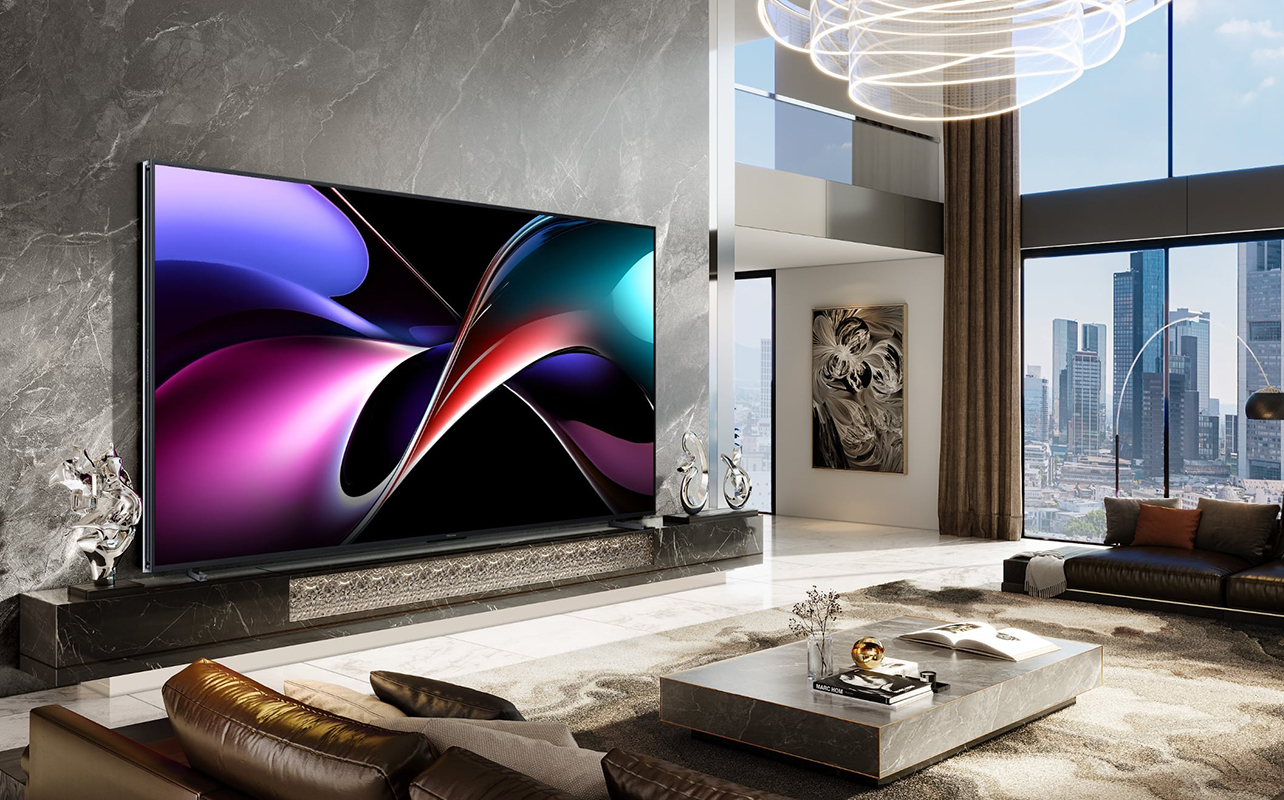
At its core, an RGB LED TV is a type of LCD TV but with a major twist in how it produces light. Traditional LED TVs use white LEDs—or blue LEDs with a yellow coating—to shine light through colour filters inside the panel. Those filters then create the red, green, and blue colours that form your picture. This new TV display technology, on the other hand, uses red, green, and blue LEDs directly as the light source. As a result, it offers richer colours, higher brightness, and improved accuracy.
If you’d like to learn more about RGB LED TVs, this TV guide is for you. Here, we’ll break down exactly what RGB LED TVs are, their key benefits, and how they differ from the TVs you know today. We’ll also feature some of the RGB LED TV models coming from major brands like Samsung, Hisense, and LG.
Time for an upgrade? Receive free Geek Squad delivery and installation with the purchase of an RGB LED TV.


How does RGB LED TV work?
Think of your TV like a stage production. In a traditional LED TV, there’s one big spotlight (the white LED) shining on all the actors. Now, imagine using coloured filters placed in front of the spotlight to try and change the light. In contrast, an RGB LED TV skips that filtering step. Instead, it uses individual red, green, and blue LEDs directly. Each tiny LED is already the right colour, which means the panel doesn’t have to rely on filters to fix the output. The result? Cleaner colours, higher brightness, and far more precision when rendering complex scenes.
Because the LEDs themselves are pure in colour, the TV doesn’t lose brightness or accuracy through filters. That means you’ll notice whites that look brighter and crisper even in daylight, reds, greens, and blues that feel more lifelike, and better contrast overall since the TV can fine-tune the balance of each LED with incredible precision.
If you’ve ever noticed that your current TV sometimes struggles with subtle shades, like a deep sunset looking a little too orange or a bright green field looking washed out, RGB LED technology is designed to fix that.
It’s important to note that RGB LED TVs are still LCD-based. They’re not self-emissive like OLED (where each pixel creates its own light). Instead, they use a next-generation backlight system that dramatically outperforms the standard white or blue LEDs found in most LCD-based TVs today.
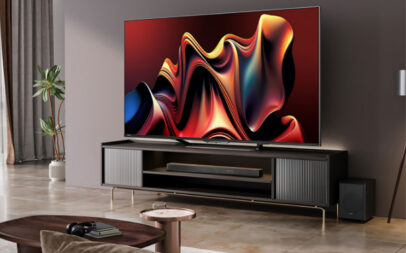
Need help understanding TV terminology?
From TV display types to resolution, refresh rates and motion technologies, we’ll break down the different TV acronyms in this handy TV guide.
What’s the difference between RGB Mini-LED and Micro RGB?
You’ll likely hear a few different names used to describe RGB LED TVs. Some brands like Hisense refer to it as RGB Mini-LED and RGBY Micro-LED, while others—most notably Samsung—use the term Micro RGB. While the naming can sound like completely different technologies, both terms generally describe the same core concept: using red, green, and blue LEDs directly in the backlight of an LCD TV.
The main distinction comes down to the size of the LEDs themselves. RGB Mini-LED TVs use very small red, green, and blue LEDs as a backlight system behind the LCD panel. Micro RGB TVs use even smaller RGB LEDs, often measuring under roughly 100 micrometres.
Because these LEDs are smaller, Micro RGB TVs can fit more of them behind the display, which allows for finer local dimming control and improved colour precision. This means the TV can adjust light more accurately across different areas of the screen, improving contrast and reducing issues like blooming.
Despite the “micro” name, it’s important not to confuse Micro RGB TVs with true Micro-LED technology. Micro-LED displays are self-emissive, meaning each pixel creates its own light. Micro RGB TVs are LCD TVs with an advanced backlight system, not self-emissive panels.
Key benefits of RGB LED TVs
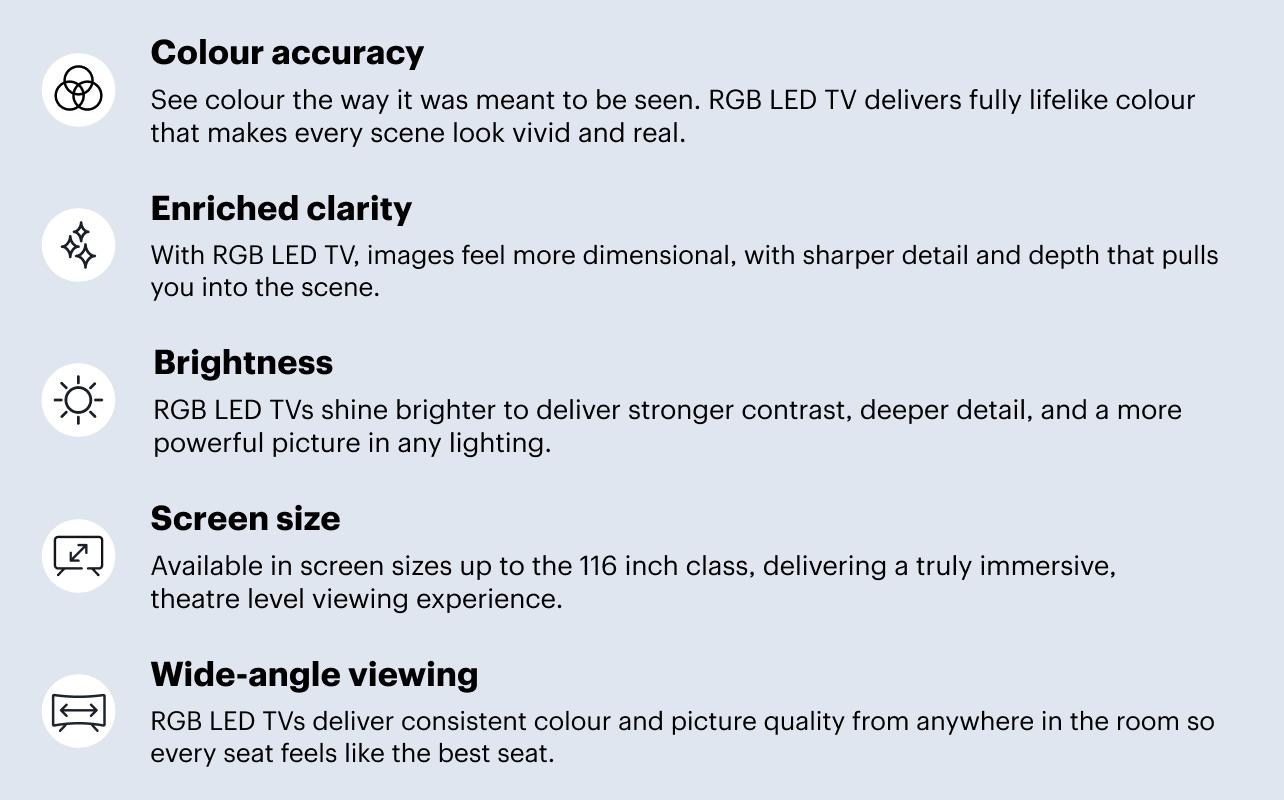
So why should you care about RGB LED TVs? Here are some of the standout benefits:
Colour accuracy
RGB LED TVs deliver accurate, fully lifelike colours that weren’t previously possible with traditional LED backlights. Because red, green, and blue LEDs are used directly, colours appear more natural and true-to-life—whether it’s skin tones, sunsets, or richly detailed landscapes.
Enriched clarity
With more precise control over light, RGB LED TVs produce sharper image clarity and finer detail. You’ll notice cleaner edges, better texture in objects, and improved depth in everything from fast-moving sports to cinematic scenes.
Brightness
RGB LED TVs’ high peak brightness helps enhance contrast and dynamic range. Bright highlights pop more, dark areas retain detail, and the overall image looks more impactful—especially in well-lit rooms.
Screen size
If bigger is better (and let’s be honest—it usually is), RGB LED TVs deliver. You can find screen sizes up to the 116-inch class so it’s easier than ever to create a true home theatre experience.
Wide-angle viewing
RGB LED TVs maintain consistent picture quality and colour accuracy even when viewed from the side. So whether you’re sitting front and centre or off to the corner, everyone gets a great view—no “best seat in the house” required.
RGB LED vs OLED
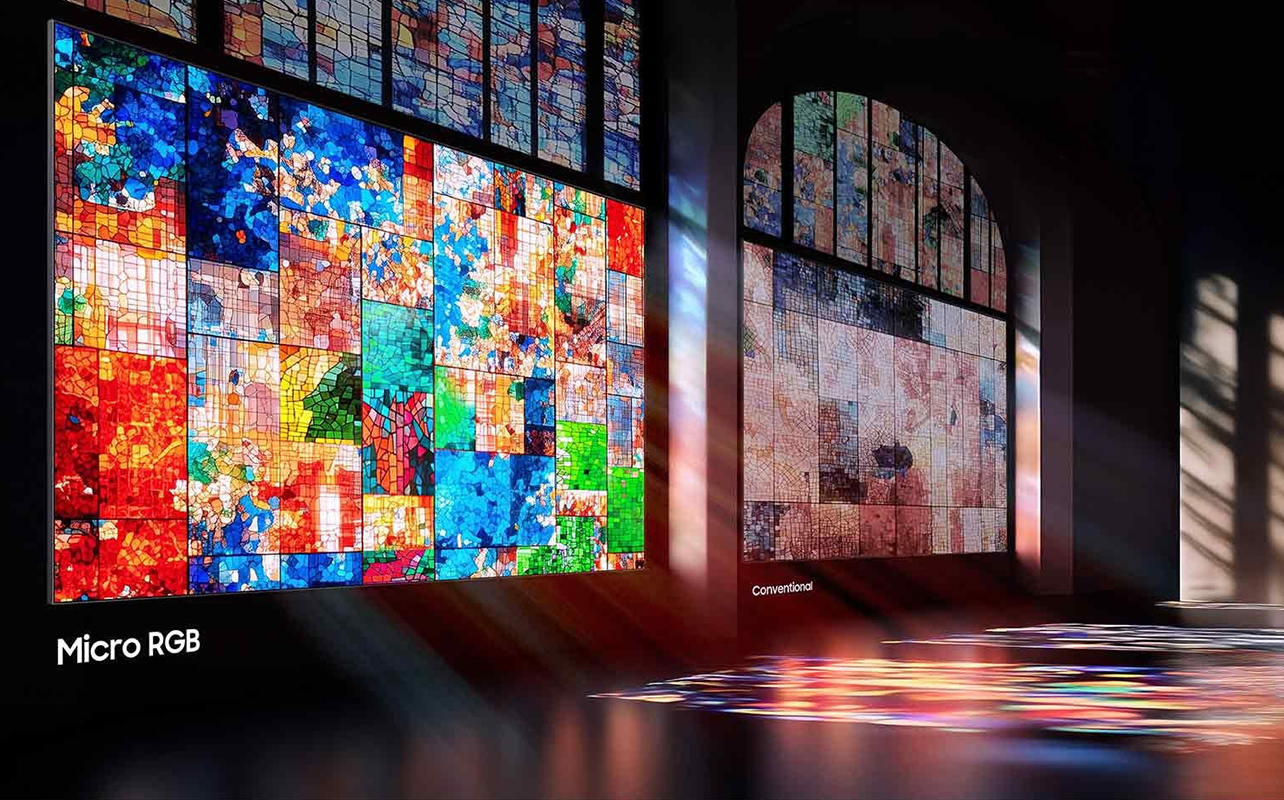
Is RGB LED TV better than an OLED TV? OLED has been the gold standard for years because of its perfect blacks and cinematic contrast. But RGB LED TVs are being pitched as a serious challenger, especially for viewers who watch in bright rooms or want a more durable display.
Here’s a quick side-by-side comparison:
| Feature | RGB LED TV | OLED TV |
|---|---|---|
| Brightness | Extremely high, ideal for daylight viewing | Lower peak brightness, better in dark rooms |
| Colour accuracy | Pure colours thanks to direct RGB LEDs | Excellent, but can struggle in very bright scenes |
| Black levels | Very good, but not perfect | Perfect blacks (each pixel turns off completely) |
| Contrast | Strong, though slightly behind OLED | Industry-leading contrast |
| Durability | No burn-in risk, long lifespan | Potential burn-in with static content |
| Viewing angles | Improved over LED, still behind OLED | Excellent from almost any angle |
The takeaway? If you watch a lot of movies in a dark room, OLED still delivers the most cinematic experience. But if you’re after brightness, colour punch, and durability, RGB LED TVs may soon become the better choice.
TV brands leading the RGB LED movement
Companies including Hisense, Samsung, LG, and TCL are all exploring ways to push colour accuracy and brightness further using RGB-based backlighting systems. Here are the RGB LED TV lineups they unveiled at CES 2026.
Samsung Micro RGB
Samsung has introduced its Micro RGB lineup with a massive 130-inch Micro RGB TV. It combines the Micro RGB backlight with advanced image processing like 4K AI Upscaling Pro and AI Motion Enhancer to keep content looking sharp and smooth. Samsung also adds technologies like Micro RGB Color Booster Pro and Micro RGB HDR Pro to enhance colour reproduction, along with Glare Free technology to reduce reflections in bright rooms. All of these translate to vibrant colours that pop off the screen and smoother motion during fast scenes like sports or action movies.
If the 130-inch is too big for your home, don’t worry! The expansive Samsung Micro RGB lineup will offer a versatile range of sizes, including the 66″ Samsung R85H Micro RGB TV reviewed by one of our bloggers.
Sony RGB LED TV
With the Sony True RGB TV, the TV brand offers the in latest TV backlight technology that uses independently controlled Red, Green and Blue LEDs. It’s the brand’s brightest and most colourful TVs at any viewing angle. Plus, it has the most advanced XR Processor to deliver all content in its purest form. It also features the next-generation True RGB backlight that maximizes colour, contrast and clarity.
Hisense RGB Mini-LED and RGBY Micro-LED
Hisense is leaning heavily into RGB-based displays with both RGB Mini-LED and RGBY Micro-LED technologies. One of the centrepieces of the lineup is the 116UXS RGB Mini-LED TV. It’s powered by the new Hi-View AI Engine RGB that provides real-time scene analysis to optimize colour, clarity, and contrast. Hisense says the technology can achieve up to 110% of the BT.2020 colour space, significantly expanding colour volume. You get to enjoy more lifelike colours and smoother gradients, especially in scenes with complex lighting.
In addition, the Hisense Mini-LED evo models add a fourth colour—Sky Blue-Cyan—to the traditional red, green, and blue LEDs. The hue is often missing from the natural light spectrum and this is where human vision is most sensitive. The additional colour helps improve gradients and realism in scenes like bright skies or flowing water while also reducing blue-light emissions for more comfortable viewing.
The company also showcased an impressive 163-inch RGBY Micro-LED TV. Adding yellow as a fourth primary colour, it delivers a vibrance and warmth with its stunning array of yellows, golds, and ambers.
LG Micro RGB evo
LG is taking its own approach with the Micro RGB evo lineup using some of the smallest RGB LEDs the company has deployed in a consumer television. It combines this backlight design with LG’s Alpha 11 AI Processor Gen 3, which simultaneously handles AI upscaling and controls the RGB lighting zones. This system enables LG to achieve 100% coverage of BT.2020, DCI-P3, and Adobe RGB colour spaces, delivering extremely wide colour reproduction. Subtle details—like skin tones, shadows, or colourful landscapes—can appear more natural and realistic on screen.
Early models are expected in larger premium sizes such as 75-, 86-, and 100-inch displays.
Need help choosing the right TV? Check out our more TV buying guides, features, and how-tos.
RGB LED TV is the next big thing
RGB LED TVs are one of the most exciting innovations in display technology we’ve seen in years. By using pure red, green, and blue LEDs as a backlight, they promise unmatched brightness, colour accuracy, and durability, features that could make them a true rival to OLED. As brands like Samsung, LG, and Hisense expand their RGB TV lineups, this technology could well become the next major step in home entertainment.
If you’re ready to make the upgrade? Check out the lineup of amazing TVs at Best Buy Canada.

This article was drafted using AI technology and then reviewed, fact-checked, and revised by a member of our editorial team.