
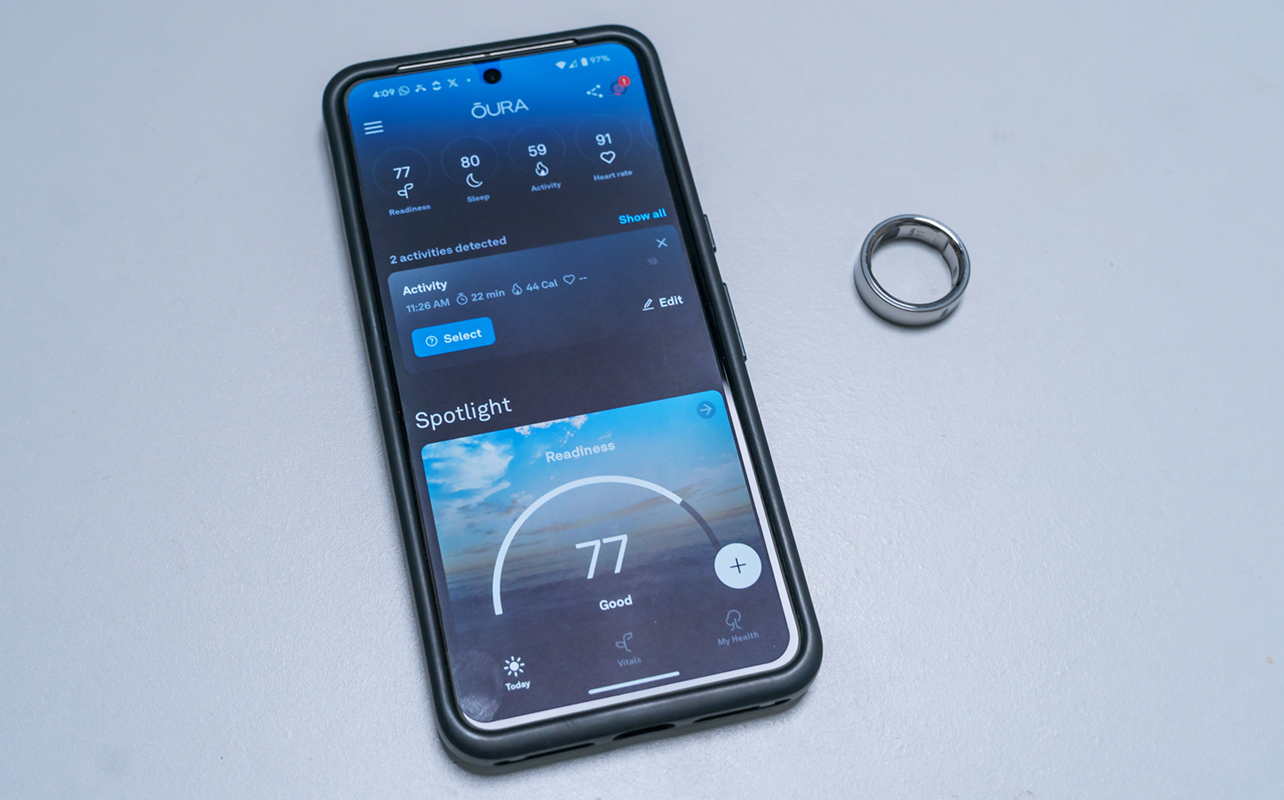
Smart rings can record a body’s basic signals through the light-based sensors to track heart rate, movement, and skin temperature, but what do those metrics actually mean? All of the data that comes from shining those sensors on your finger end up in a companion app that’s worth looking at every morning.
HRV, SpO₂, readiness, sleep score—all of these terms are measurements onscreen. A smart ring can do a lot but interpreting the data is the important part. It’s one thing to look at sleep data from the night before and another to gauge how the body is handling things over weeks or months. Let’s go over what each major metric measures, what it can reasonably suggest, and why tracking change over time matters more than any single number.

Table of contents
- Introduction
- What smart ring metrics actually mean
- Heart rate
- HRV: What it can suggest about recovery and stress
- Skin temperature: Trends, illness signals, and cycle tracking context
- SpO2: Oxygen variation during sleep
- Sleep score: Why it’s a summary, not a sleep study
- Activity and readiness scores
- Why trends matter more than one-day readings
- FAQs

What smart ring metrics actually mean
A smart ring features various sensors in a very small space. These include a photoplethysmography (PPG) sensor that shines light through the skin to detect blood flow, an infrared temperature sensor, an accelerometer for movement, and (in many cases) a blood oxygen (SpO2) sensor.
Then there are the secondary metrics coming from them, like heart rate, heart rate variability, temperature deviation, overnight oxygen levels, and composite scores like sleep score or readiness score that combine several inputs into one number.
A good way to parse all this is to look at it as two parallel points. First are the physiological signals, such as heart rate, temperature, and oxygen saturation. Second are the scores the ring’s companion app records through built-in proprietary algorithms that vary by brand. Hence, a sleep score from one ring isn’t directly comparable to a sleep score from another because the formula differs.
The key is to recognize the figures as baseline indicators rather than medical facts. A smart ring can’t diagnose a specific condition but can act as a sort of “warning sign” for something that might be brewing, especially if you notice a pattern. The data can be valuable when seeing a doctor, who can provide necessary care.
Heart rate
The most critical data point a smart ring collects is heart rate because it forms the foundation for everything else. The onboard PPG sensors enable the rings to measure it continuously by detecting the tiny changes in blood volume with each heartbeat. Fingers have a high density of blood vessels close to the skin, which is why ring-based sensors can deliver a clean and stable signal. That’s especially true during sleep where there’s less chance of movement compared to a smartwatch.
Resting heart rate, which the ring captures during periods of the day where you’re least active, is generally the most useful number to watch. A person’s resting heart rate that trends noticeably higher than their baseline can reflect ordinary causes such as poor sleep, dehydration, alcohol, stress, or the early stages of illness.
That doesn’t necessarily mean an elevated reading on a single morning is cause for concern on its own. The picture becomes clearer over several days alongside other shifts, such as a lower sleep score or unusual temperature readings.
HRV: What it can suggest about recovery and stress
Heart rate variability, or HRV, measures the small variation in timing between individual heartbeats. While it might seem counterintuitive, you actually want to see more variability because it generally suggests the nervous system is adapting well to daily demands. A lower, flatter pattern can suggest the body is under more strain. It’s ultimately about the balance between how the nervous system handles stress response relative to rest and recovery.
HRV is also pretty individual. There is no universal “good” number, so it’s not worth comparing your HRV to someone else’s. What matters is one’s own baseline established over weeks of consistent measurement, and how a given night compares to it.
A dip below a typical range can suggest lagging recovery, be it from a hard training session, poor sleep, alcohol, illness, or emotional stress. Just bear in mind it’s worth noting rather than seeing it as a lasting verdict. Various factors on any given day can influence HRV, and that’s why short-term dips are common and usually innocuous.
Skin temperature: Trends, illness signals, cycle tracking context
Smart rings don’t measure core body temperature, they measure skin temperature at the finger. It can fluctuate for many non-health reasons, like room temperature, bedding, and alcohol. The key to this data isn’t the absolute number but how it does (or doesn’t) deviate from your own nightly baseline. Since you wear the ring continuously, it can establish a stable reference point and flag when a given night runs noticeably warmer or cooler than usual.
When overnight skin temperature sees sustained upward trends, there is research suggesting they may be early stages of illness before other symptoms are noticeable. This is why temperature data has grown in popularity for its early-warning potential, though you still have to take it as a warning, not a diagnosis.
Temperature tracking also has a connection to menstrual cycles. Since skin temperature shifts in a predictable pattern across the cycle, it could help identify fertile windows or confirm ovulation. In both cases, an isolated reading says little. It’s how the trends shapes out over days or weeks that matters more.

SpO2: Oxygen variation during sleep
Blood oxygen saturation, or SpO2, reflects how much oxygen red blood cells carry, measured in percentage. Smart rings measure this overnight, gauging how oxygen levels fluctuate through the sleep cycle. The ideal range is anything above 95%.
This data becomes more relevant when identifying a consistent pattern of larger or more frequent dips night after night, which can be associated with disrupted breathing during sleep. As in other data points coming from smart ring features, SpO2 information isn’t diagnostic, though it can be instructive.
Your best bet is to talk to your doctor or go through a clinical sleep evaluation to confirm or rule out sleep apnea or some other breathing-related sleep issue. As with other metrics, the useful signal is the pattern across many nights, not any single reading.
Sleep score: Why it’s a summary, not a medical sleep study
The sleep score comes from a composite of the different inputs, like total sleep time, sleep stages, movement during sleep, resting heart rate, and HRV. Not every manufacturer follows the exact same formula, which is why you may see different scores on different devices. The whole point is to compress a night’s worth of data into something easy to glance at each morning.
It’s also worth knowing what a sleep score isn’t. It’s no substitute for a clinical study in a sleep lab with dedicated brainwave monitoring. Smart ring features have no access to brainwaves given the heart rate data is the primary data point. Thus, stage-by-stage accuracy may not match what a clinic can find out, even when total sleep time estimates are reasonably close. Treat the score as a consistent gauge that’s most useful when compared against your own history, not as an exact clinical measurement.
Activity and readiness scores
Alongside sleep, most smart rings generate an activity score by tracking movement, steps, and exercise intensity. This helps determine a readiness score, which combines the aforementioned metrics with activity tracking to come up with a number suggesting how prepared your body might be for that day. It gives you a sense of whether you can work out harder or ease up.
Readiness scores carry the same caveats. A low score after one unusual night isn’t a strong signal on its own. For example, a score trending downward over a week, alongside a rising resting heart rate and falling HRV, paints a more coherent picture of accumulating fatigue or stress. Consider these scores as a nudge toward paying attention, not a strict rule to follow.
Why trends matter more than one-day readings
Every metric covered here shares the same limitation and the same strength: individual readings are interesting, but patterns over time are informative. No need to feel alarmed over a single night of poor HRV, an elevated temperature reading, or a low sleep score. It’s the patterns that tell a bigger story.
Smart rings are best at establishing a personal baseline through weeks of collecting data consistently, then helping understand what might be causing it. Together, a climbing resting heart rate, an HRV that stays below its usual range, warmer temperatures for several nights in a row, and a sliding sleep score, signify a more meaningful pattern than any one signal alone.
This is why it’s best to treat smart ring data as a long-term record rather than a daily verdict. It can record change but not diagnose the underlying cause. Understanding that distinction actually makes it a lot more valuable as a wearable device.
Check out the latest smart rings available now.
FAQ
What do smart ring metrics actually mean?
The metrics come from onboard sensors that track blood flow, movement, and temperature. They’re designed to reflect general trends and patterns rather than precise clinical measurements. Check out our guide on choosing the right smart ring for you.
What does heart rate tell you on a smart ring?
Continuous heart rate, especially resting heart rate, gives a general sense of how the body is handling daily stress, sleep quality, and physical demands. A single elevated reading is common and usually not significant on its own.
What is HRV, and what can it suggest about recovery and stress?
Heart rate variability measures the variation in time between heartbeats. Higher variability relative to a person’s own baseline is generally associated with better recovery and stress resilience. A lower pattern can suggest the body is under more strain.
What does skin temperature mean on a smart ring?
Rings track skin temperature on the finger relative to a person’s own nightly baseline, not absolute core body temperature. Deviations from that baseline are more informative than the raw number itself.
Can temperature trends help identify changes over time?
Yes. Sustained shifts in overnight skin temperature can align with the early stages of illness or with predictable phases of the menstrual cycle. The catch is that it works only as a trend observed over multiple nights, not from a single reading.
What does SpO2 measure during sleep?
SpO2 tracks blood oxygen saturation overnight to observe how oxygen levels fluctuate through the sleep cycle. Occasional minor dips are normal. Larger dips over many nights are more relevant.
What does a sleep score actually mean?
A sleep score is a composite number coming from sleep duration, sleep stages, movement, and heart rate data, summarizing a night’s sleep into a single figure that is easier to track over time.
Is a sleep score the same as a medical sleep study?
No. A sleep score is derived from movement and heart rate estimates, not direct brainwave monitoring, so can’t diagnose sleep disorders the way a clinical study can.
What are activity and readiness scores?
Activity scores summarize daily movement and exercise, while readiness scores combine recovery-related signals such as HRV, resting heart rate, and sleep quality to suggest how prepared the body may be for the day ahead.
Why do trends matter more than one-day readings?
Many ordinary and temporary factors can impact daily readings, so one-day readings aren’t as clear. A far more reliable signal is in how multiple metrics shift across several days or weeks.
When should you talk to a healthcare professional about smart ring data?
If you notice a persistent, unexplained change in your metrics over an extended period, or suspect specific health concerns, like sleep apnea or an irregular heartbeat, that’s when you should bring the data to a doctor rather than trying to interpret it alone.
Are smart ring wellness metrics a diagnosis?
No. Think of every smart ring metric as a wellness indicator to raise awareness and recognize patterns. None of them are designed or validated to diagnose a medical condition.