
Choosing a laptop for school today is less about picking between “cheap” and “expensive” and more about deciding how you want to balance performance, price, and long-term usability.
Both refurbished and new laptops can work extremely well for school use. The key difference is not whether one is universally better, but how well each aligns with your budget, workload, and expectations around reliability and lifespan.
For many students, the most important shift in thinking is this: instead of focusing on whether a laptop is new or refurbished, it’s far more useful to focus on specifications, warranty coverage, and long-term usability.
A well-chosen refurbished device can easily outperform a low-end new laptop in everyday tasks. At the same time, a new laptop can offer peace of mind and consistency over several years of study.
Before going deeper, let’s see the trade-offs clearly.

Table of contents
- Refurbished vs. new laptops at a glance
- Recommended student laptop specs for 2026
- What refurbished and new laptops actually mean
- Refurbished vs. used vs. new laptops
- How the two options compare for students
- Which laptop type suits different student needs
- What to check before buying

Refurbished vs. new laptops at a glance
Here’s a simple breakdown of how both options generally compare for students.
| Factor | Refurbished Laptop | New Laptop |
|---|---|---|
| Price | Lower entry cost | Higher upfront cost |
| Performance per dollar | Often significantly better | Moderate depending on model |
| Warranty | Varies by seller and program | Full manufacturer warranty |
| Battery condition | Varies by usage and refurbishment | Brand new battery |
| Cosmetic condition | Minor wear possible | Flawless finish |
| Hardware generation | May be 1–4 years old | Latest generation |
| Software support lifespan | Depends on model age | Longer guaranteed support |
| Best suited for | Value-focused students | Long-term, low-risk use |
What this table doesn’t fully capture is how differently these devices can feel in real use. A refurbished laptop with higher RAM and a better processor can feel smoother than a new budget device with weaker specs. That’s why specification matching is so important.
Recommended student laptop specs for 2026
One of the biggest mistakes students make is focusing too much on whether a laptop is refurbished or new and not enough on the specifications. In fact, the specs often matter more than the age of the device. A well-equipped refurbished laptop can easily outperform a brand-new entry-level model if it has more memory, better storage, and a stronger processor.
Here are practical baseline recommendations for students:
| Student type | Recommended specs |
|---|---|
| High school students | Intel Core i5 or AMD Ryzen 5, 16GB RAM, 512GB SSD |
| College and university students | Intel Core Ultra 5 or AMD Ryzen 5, 16GB RAM, 512GB SSD |
| Coding and STEM students | Intel Core Ultra 5 or better, AMD Ryzen 7 or better, 16GB–32GB RAM, 512GB–1TB SSD |
| Creative students | Intel Core Ultra 7, AMD Ryzen 7, or Apple M-series chip, 16GB–32GB RAM, 1TB SSD |
If you’re still learning what specifications matter most, it’s worth reading our guide on what laptop specs do students actually need, which breaks down processors, RAM, storage, battery life, and other key features in more detail.
What refurbished and new laptops actually mean
Understanding these categories properly is essential before comparing them.
How refurbished laptops are restored
A refurbished laptop is not simply a used laptop being resold. Each device goes through a structured refurbishment process to ensure it meets defined performance and quality standards before being resold. Depending on the device and refurbishment program, this process may include:
- Full diagnostic testing of hardware components
- Replacement of defective or worn parts (such as batteries or storage drives)
- Deep cleaning of internal and external components
- Operating system reinstallation and software verification
- Stress testing to confirm performance stability
- Quality inspection before resale
The goal is consistency and reliability, not just resale.
If you want a deeper breakdown of how this works in practice, this article What is a refurbished laptop and why you should consider one explains the refurbishment lifecycle in more detail and why it has become a trusted option for many students.
How new laptops differ from refurbished devices
New laptops, by contrast, are completely unused units that come directly from manufacturers or authorized retailers.
This means:
- Every component is brand new, including the battery
- Hardware is the latest available generation
- Software support is typically at its longest possible cycle
- No previous usage history or wear concerns
For students planning to keep a device for multiple years without upgrades, this predictability is often a major advantage.
However, that “newness” often comes at the expense of specifications in lower price ranges, where compromises are made to meet budget targets.
Refurbished vs. used vs. new laptops
This is one of the most important distinctions students should understand, because it directly affects risk.
| Type | Meaning |
|---|---|
| New | Factory-sealed, unused laptop sold by manufacturer or retailer |
| Refurbished | Previously used device tested, repaired, and certified for resale |
| Used | Sold as-is, typically with no testing or repair process |
The difference between refurbished and used is especially important. A used laptop might be functional, but without testing or warranty support, the buyer assumes significantly more risk. Refurbished devices reduce that uncertainty by introducing quality control steps before resale.
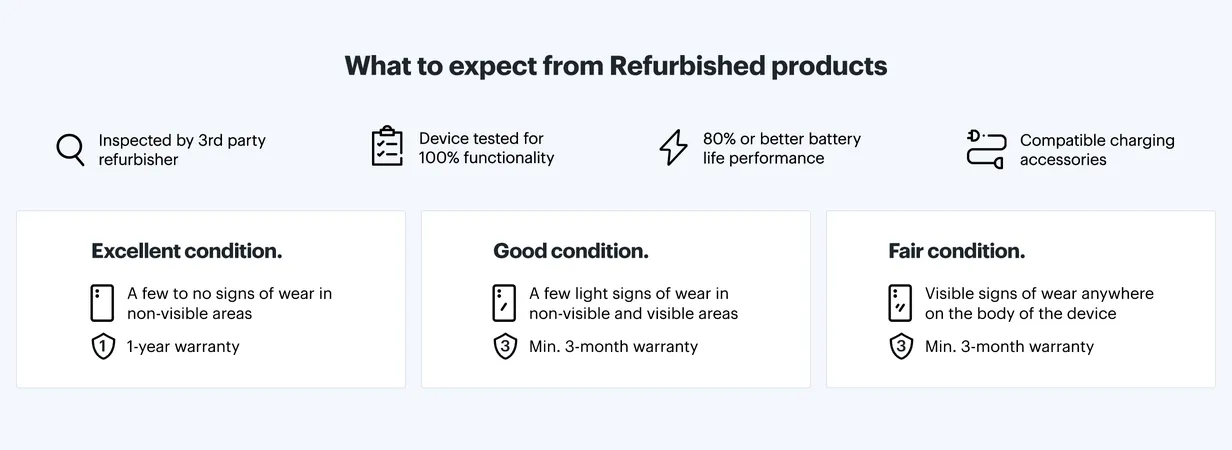
At Best Buy, refurbished laptops are evaluated through a standardized process that includes testing, inspection, and condition grading before being offered for resale. Here’s what you get:
- Certified compatible charging accessories – Each refurbished laptop from Best Buy includes a compatible charger, so you don’t have to worry about third-party accessories that may damage the device or cause slow charging.
- Inspected by certified refurbishers – Every laptop is examined and repaired by trained professionals to ensure it functions properly. This includes testing the display, keyboard, trackpad, ports, and internal components like the processor, RAM, and storage.
- Devices tested for 100% functionality – Before a laptop is approved for sale, it goes through a full diagnostic check, ensuring all hardware and software features work as expected. This prevents performance issues that are common in used or uncertified refurbished laptops.
- Battery health guarantee – All refurbished laptops come with a minimum battery performance of 80% or better, meaning they still hold a strong charge and can last through normal daily use. This is a major advantage over purchasing a used laptop from an individual seller, where battery life is often unpredictable.
How the two options compare for students
Price and overall value
For most students, budget is the starting point.
Refurbished laptops often make it possible to access higher-tier hardware at a lower cost. Instead of paying for the latest generation, students can prioritize practical performance improvements like more memory, faster storage, or better build quality.
This is especially relevant for students looking for budget laptops that still handle multitasking smoothly.
New laptops, however, frequently benefit from promotions, student discounts, and seasonal sales that can reduce the price gap. In some cases, a new device may be close in price to a refurbished one, depending on timing and model.
The key takeaway: value is not just price—it’s performance per dollar.
Battery life and everyday reliability
Battery performance directly affects how long a laptop can realistically support a full school day without needing a recharge.
New laptops offer the advantage of:
- Full battery capacity from day one
- More predictable runtime
- Improved energy efficiency in newer chips
Refurbished laptops vary more widely. Some may include replaced batteries or lightly used components, while others may show reduced capacity depending on prior usage.
For students who rely on campus mobility—moving between classes, libraries, and study spaces—battery condition becomes one of the most important practical considerations.

Performance, RAM, and storage
Performance in student laptops is less about raw power and more about consistency during multitasking.
Three components matter most:
- RAM (memory)
This determines how many applications can run smoothly at the same time. Students often juggle browsers, documents, video calls, and research tools simultaneously. For most students, 16GB RAM is now the recommended baseline for smooth multitasking and long-term usability. - SSD storage
Solid-state drives dramatically improve system responsiveness. Everything from startup time to file access becomes noticeably faster compared to older hard drives. - Processor
While important, most modern mid-range processors are already more than capable for student workloads.
A key advantage of refurbished laptops is that older premium models often include stronger CPUs and more RAM than newer budget models, making them feel faster in real use.
Warranty, returns, and seller trust
Warranty coverage is one of the most important risk factors in any laptop purchase.
New laptops typically include:
- Full manufacturer warranty
- Standardized support channels
- Clear repair or replacement policies
Refurbished laptops depend heavily on the seller or program. Reputable refurbishers usually provide:
- Limited but structured warranty coverage
- Defined return windows
- Certified testing standards
This is why choosing a trusted retailer with standardized testing and return policies is just as important as choosing the right device itself.
For example, browsing curated collections like refurbished products or refurbished laptops and MacBooks at Best Buy helps ensure consistent quality standards compared to informal resale marketplaces.
Which laptop type suits different student needs
Basic schoolwork
For tasks like writing assignments, browsing, email, and online classes, refurbished laptops are often more than sufficient. They provide strong value without unnecessary cost.
Demanding academic programs
Some fields require more computing power:
- Engineering programs rely on simulation and CAD tools
- Creative programs involve video editing and design software
- Computer science students often run development environments and virtual machines
In these cases, either a higher-end refurbished device or a newer laptop with stronger hardware may be appropriate.
When refurbished makes more sense
Refurbished laptops are especially strong when:
- Budget is a primary concern
- Higher specifications are needed at a lower price
- The device is secondary or backup use
- The workload is moderate (writing, browsing, productivity)
- You are comfortable evaluating condition and warranty details
In these situations, refurbished devices often deliver the best balance of performance and affordability.
When new is worth the extra cost
A new laptop becomes more valuable when:
- You need long-term consistency over several years
- Battery life is critical for daily use
- You rely heavily on your laptop for academic or professional work
- You prefer full manufacturer support
- You want the latest hardware and features
For students in longer programs, this stability can outweigh the upfront savings of refurbished devices.
Recommendation table
| Student Need | Better Option |
|---|---|
| Budget-focused school laptop | Refurbished |
| Long-term university use | New or premium refurbished |
| Coding & STEM programs | Depends on specs |
| Creative workloads | New or high-end refurbished |
| Everyday productivity | Refurbished |
What to check before buying
Before making a final decision, it helps to evaluate a few key technical and practical details that directly affect long-term satisfaction.
Condition grades and listing details
Refurbished laptops are usually categorized as Excellent, Good, or Fair. These grades reflect cosmetic condition rather than performance quality.
Even a “Good” condition laptop can perform identically to an “Excellent” one, making lower grades a way to save money if appearance is not a priority.
Battery health and lifespan
Battery condition affects portability and convenience.
Key considerations include:
- Number of charge cycles
- Whether the battery has been replaced
- Expected daily runtime
- Replacement cost if needed
This is especially important for students who rely on all-day mobility.
Brand, model, and long-term support
Some laptops age better than others. Look for:
- Reliable brands with strong support cycles
- Models with upgrade potential (where applicable)
- Long-term OS support availability
Questions to ask the seller
Before buying, always confirm:
- Warranty duration and coverage
- Battery condition details
- Return policy terms
- Included accessories (charger, cables, etc.)
Checklist for smarter buying
| Item | Why it matters |
|---|---|
| RAM amount | Multitasking performance |
| SSD storage | System speed and responsiveness |
| Battery health | Daily portability and usage time |
| Warranty coverage | Reduces financial risk |
| Seller reputation | Ensures product reliability |
Final thoughts
Whether you choose a refurbished or new laptop, focusing on specifications, battery health, warranty coverage, and long-term value will help you make the right decision for your needs. The best option isn’t necessarily the newest or least expensive—it’s the one that supports your coursework, study habits, and budget over the years ahead.
If you’re still comparing options, Best Buy’s selection of refurbished laptops and MacBooks is a great place to explore different configurations, performance levels, and price points. You can also browse the broader refurbished products collection to discover additional ways to save on technology for the school year.
Frequently asked questions
Are refurbished laptops safe for school?
Yes. When purchased from reputable sellers and supported by warranty coverage, refurbished laptops are reliable for everyday school use, including assignments, research, and online learning.
How much can students save with a refurbished laptop?
Students can often save hundreds of dollars compared to new devices while still accessing similar or better specifications for everyday workloads.
What specs matter most for students?
RAM, SSD storage, processor efficiency, and battery life matter far more than cosmetic condition or having the latest design.
Should students buy refurbished or new laptops?
Refurbished laptops are often better for budget-conscious students, while new laptops may be better for long-term use or demanding academic workloads.
What warranty should students expect?
Warranty coverage varies, but students should ideally look for several months of protection along with a clear and simple return policy.