
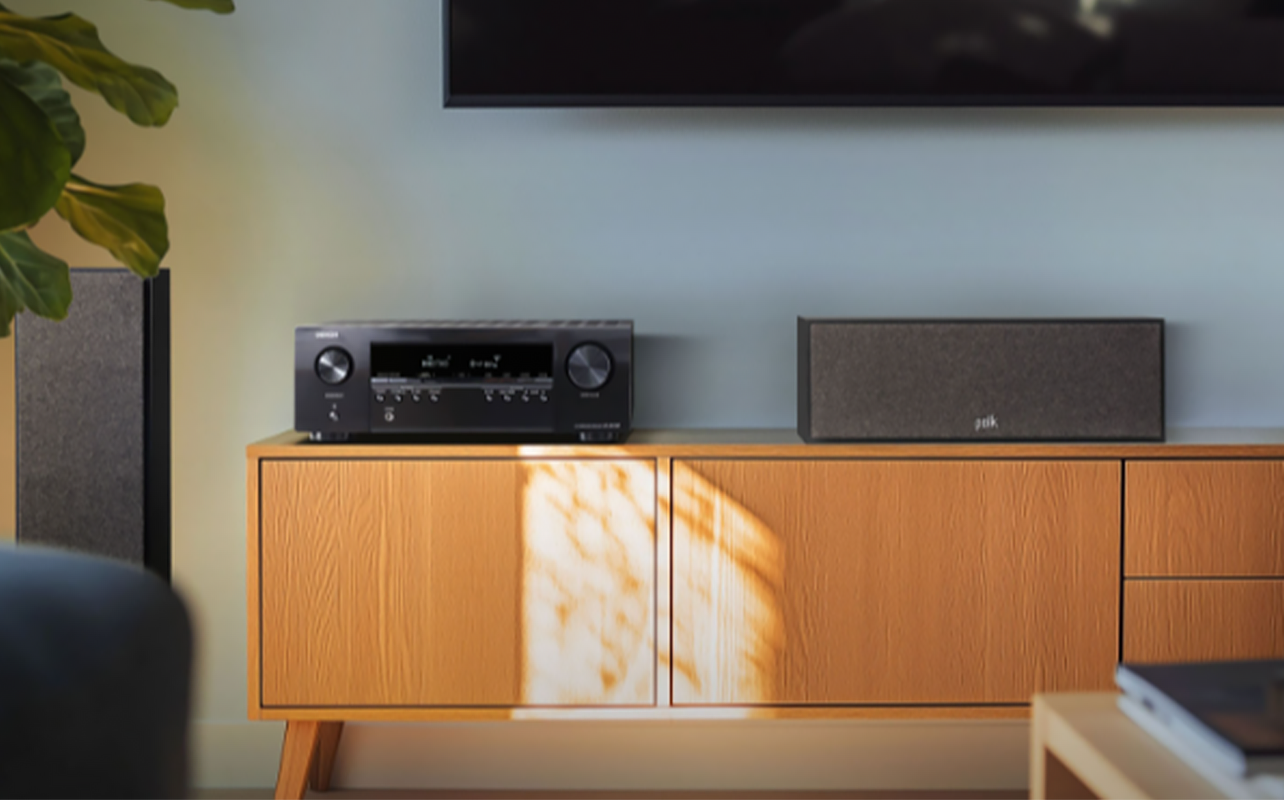
Should you buy a receiver or an amplifier? These devices improve your sound system and power your speakers. However, both are designed for different types of listening experiences and setups. Receivers combine amplification with built-in controls, source switching, and connectivity features. Amplifiers, on the other hand, focus primarily on boosting audio signals for cleaner and more powerful sound.
Whether you’re building a full surround sound home theatre or simply want richer stereo audio for music and TV, understanding the difference between a receiver and an amplifier can help you avoid overspending on features you may never use.

Table of contents:
- What is a receiver?
- What is an amplifier?
- Differences between receivers and amplifiers
- Receiver vs amplifier: Which sounds better?
- Things to consider when choosing the right setup
- Frequently asked questions
What is a receiver?
A receiver is the central component of an audio or home entertainment system. It receives audio signals from connected devices, processes them, powers speakers through built-in amplification, and allows you to switch between different audio or video sources.
For example, you might connect a gaming console, streaming device, and Blu-ray player to a receiver. And then, use it to switch between gaming, Netflix, or movies without constantly changing TV inputs. In a home theatre setup, it can also decode surround sound so a movie soundtrack feels more immersive and directional.
Need help choosing the right receiver? Here’s our receiver buying guide.
There are two common types of receivers:
Stereo receivers
Primarily designed for two-channel music listening setups, a stereo receiver focuses mainly on audio playback and usually powers two speakers for music listening. Many stereo receivers also include built-in AM/FM radio tuners, Bluetooth connectivity, and streaming features for simple home audio setups.
AV receivers
Also called a home theatre receiver, an audio-video receiver is designed for multi-speaker surround sound home theatre systems. It acts as the command centre for a full entertainment system. It connects to your TV, speakers, gaming consoles, streaming devices, Blu-ray players, and more while managing both audio and video signals. AV receivers are specifically designed for immersive surround sound and multi-speaker configurations.
Modern receivers can perform several jobs at once. They receive audio and video signals from your devices, process those signals, power connected speakers, and distribute sound throughout your room. AV receivers also include advanced features designed for home theatre performance and easier system management.

Common features of receivers
Many modern receivers—especially AV receivers—include a wide range of built-in features designed to simplify home entertainment setups and improve audio performance. Check the receiver specs if they include any of these features:
- Built-in amplification for speakers: Powers connected speakers directly, allowing one unit to drive everything from small bookshelf speakers to larger floor-standing setups without needing a separate amp.
- HDMI inputs for devices: Lets you connect consoles, streaming boxes, and Blu-ray players to one hub, then send video to the TV while routing audio to your speakers.
- Surround sound support (Dolby Atmos, DTS:X): Decodes cinematic audio formats and distributes sound across multiple speakers for a more immersive experience.
- Video switching hub: Allows you to switch between devices through the receiver instead of plugging and unplugging HDMI cables from your TV.
- Bluetooth and Wi-Fi streaming: Streams music wirelessly from phones or taps into apps and internet radio over Wi-Fi for higher-quality playback.
- AirPlay compatibility: Enables Apple users to stream audio directly from iPhone, iPad, or Mac without additional hardware or cables.
- Auto-calibration for room tuning: Uses a microphone to analyze your room and automatically adjusts speaker levels, distance, and timing for balanced sound.
- Multi-room audio support: Sends audio to different rooms or zones so you can play different music in each space or sync playback across the house.
- Core advantage—surround sound: Especially in AV receivers, multi-channel support creates a full cinematic setup ideal for movies, sports, and gaming.
For a closer look at what to compare, see different AV receiver features to consider for your home theatre setup
Types of AV receivers by channel configuration
You’ll often see AV receivers described by channel configurations like:
- 5.1-channel: This is one of the most common home theatre configurations. It delivers immersive surround sound without requiring a huge amount of space. In a 5.1 setup, the first number refers to five speakers: front left, centre, front right, surround left, and surround right. The “.1” refers to one subwoofer, which handles low-frequency bass effects for deeper impact during movies and music.
- 7.1-channel: This type of setup builds on 5.1 by adding two extra rear surround speakers behind the listening area. These additional speakers help create more spacious rear audio effects and improve sound movement around the room.
- 9.2-channel: A 9.2-channel setup expands the experience even further. The first number refers to nine amplified channels, while the “.2” indicates dual subwoofers. This type of setup is often used in larger home theatres. The additional speakers create a wider and more immersive soundstage, while dual subwoofers help produce fuller and more balanced bass throughout the room.
If you want that cinematic “sound moving around the room” experience, an AV receiver is typically the way to get there. Stereo receivers, by comparison, are usually designed for traditional two-speaker listening setups focused more on music playback than immersive surround sound.
What is an amplifier?
An amplifier has a more focused job: it strengthens an audio signal so your speakers can produce clear, powerful sound. Instead of acting as a complete entertainment hub, an amplifier concentrates primarily on audio performance. It takes a weak audio signal and increases its power enough to drive speakers effectively.
Amplifiers are often associated with stereo listening setups and music-focused systems, though they can also be used in more advanced home theatre configurations.
Key amplifier components and functions
Amplification circuitry
The amplification circuitry is the core component responsible for increasing the strength of an incoming audio signal. It takes a weak signal from a source device, such as a music player or turntable, and boosts it so the connected speakers can produce clear and powerful sound at higher listening volumes.
Gain or volume control
Gain or volume controls allow users to adjust how much the audio signal is amplified before reaching the speakers. Lower settings reduce output volume, while higher settings increase loudness and listening intensity based on user preference.
Audio inputs and outputs
Audio inputs receive signals from connected devices like TVs, CD players, turntables, or streaming devices. Outputs then send the amplified signal to connected speakers or audio equipment so the sound can be reproduced.
Power supply for signal amplification
The power supply provides the electrical energy needed for the amplifier to function properly. A stable and capable power supply helps the amplifier deliver consistent performance, cleaner sound reproduction, and enough power to drive speakers effectively without distortion.
Types of amplifiers
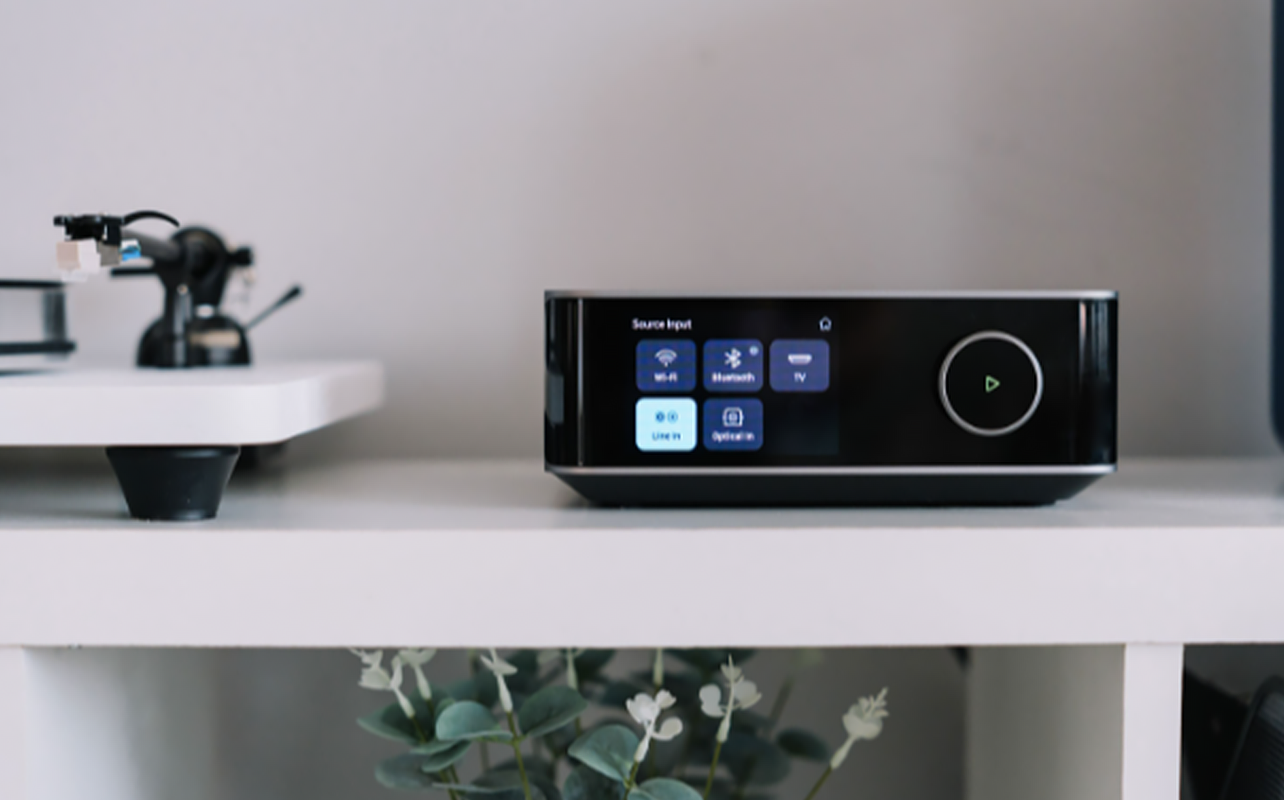
There are also different types of amplifiers that can sometimes confuse first-time buyers.
Preamp vs power amp: A preamplifier (preamp) processes weak audio signals and may include tone controls or input switching before passing the signal onward. A power amplifier then boosts that signal enough to drive speakers.
Integrated amplifier: An integrated amplifier combines both the preamp and power amp into one unit. These are popular because they simplify setup while still focusing heavily on audio quality. Integrated amplifiers are commonly used in stereo systems with two speakers, especially for music listening.
Unlike receivers, amplifiers typically focus more on audio amplification and sound performance rather than system management, surround sound processing, or extensive connectivity features.
Differences between receivers and amplifiers
While both receivers and amplifiers improve your sound system, they’re built with different priorities in mind.
Versatility
Receivers are designed to combine several functions into a single device. Both stereo receivers and AV receivers include built-in amplification, input switching, and source controls, allowing them to act as the central hub of an entertainment system. Stereo receivers are generally built for two-channel music listening, while AV receivers expand those capabilities with surround sound processing, HDMI connectivity, and advanced home theatre features.
AV receivers are especially versatile because they handle multiple tasks at once, including powering speakers, processing surround sound formats, switching between connected devices, and managing both audio and video signals. Many AV receivers also include wireless streaming features like Bluetooth and Wi-Fi, making them convenient for modern entertainment setups. If your setup includes a TV, gaming console, streaming box, Blu-ray player, and multiple speakers, an AV receiver can simplify everything by managing all your connections in one place.
Amplifiers take a more specialized approach. Rather than functioning as complete entertainment hubs, amplifiers focus primarily on boosting audio signals and delivering clean, powerful sound to speakers. This simpler design allows many amplifiers to prioritize stereo sound quality and detailed music reproduction.
Because of this focus, amplifiers are especially popular among music enthusiasts, stereo listeners, vinyl collectors, and users who prefer a simpler audio setup. Most stereo amplifiers power two speakers, although some also support subwoofers in 2.1-channel systems. Instead of emphasizing surround sound immersion, amplifiers are often appreciated for music clarity, stereo imaging, tonal balance, and detailed sound reproduction.
Connectivity
Connectivity is one of the biggest advantages of receivers. Many models include multiple HDMI inputs so you can connect devices like a game console, streaming stick, and Blu-ray player at the same time, then switch between them instantly without touching your TV settings. HDMI eARC support also allows high-quality audio to pass from your TV back to the receiver, which is especially useful for smart TV apps like Netflix or Disney+.
Bluetooth and Wi-Fi connectivity make it easy to stream music directly from a phone or access services like Spotify or Apple Music without extra equipment. Advanced room calibration systems can even detect your speaker layout and room size, then automatically adjust sound settings so a movie sounds balanced whether you’re sitting on a couch or at the back of a larger room.
Amplifiers, by comparison, usually offer fewer connectivity options because they are designed with a more focused purpose: delivering clean audio performance. Some modern integrated amplifiers now include HDMI ARC for TV connection or Bluetooth streaming for convenience, but they still tend to avoid the full suite of HDMI switching, surround processing, and multi-device control that receivers provide.
Surround sound vs stereo sound
One of the biggest differences between receivers and amplifiers is the type of listening experience they’re designed to deliver. AV receivers are built primarily for immersive surround sound, while most amplifiers and stereo receivers focus more on traditional two-channel stereo audio.
AV receivers are specifically designed to decode immersive audio formats like Dolby Atmos and DTS:X, allowing sound effects to move around and above the listener. In a typical surround sound setup, front speakers handle the main audio, centre channel speakers reproduce dialogue, surround speakers create environmental effects, and subwoofers add deep bass impact. Together, these channels create the cinematic experience many people want from a dedicated home theatre.
Amplifiers and stereo receivers, by comparison, are usually focused on two-channel audio reproduction. Rather than emphasizing surround effects, these systems prioritize music clarity, stereo imaging, tonal balance, and detailed sound reproduction. For many music lovers, that simplicity can actually be a major advantage.
Side by side comparison
This chart breaks down the core features, strengths, and ideal use cases for each so you can choose the right setup.
| Feature | Receiver | Amplifier |
|---|---|---|
| Primary purpose | Acts as the central hub for audio or home entertainment systems | Focuses mainly on boosting audio signals and powering speakers |
| Best for | Home theatres, gaming, movies, TV, and multi-device setups | Music listening, stereo systems, vinyl, and focused audio playback |
| Types | Stereo receivers and AV receivers | Stereo amplifiers, integrated amplifiers, preamps, and power amps |
| Speaker support | Stereo or multi-speaker surround sound setups | Usually two-channel stereo setups |
| Surround sound | AV receivers support Dolby Atmos, DTS:X, and multi-channel surround sound | Most amplifiers focus on stereo sound rather than surround sound |
| HDMI connectivity | Common on AV receivers for TVs, consoles, and streaming devices | Limited or unavailable on many models |
| Video support | AV receivers can switch and process video signals | No video processing |
| Wireless features | Often includes Bluetooth, Wi-Fi, AirPlay, and streaming support | Some integrated amps include Bluetooth or streaming, but fewer features overall |
| Device management | Can manage TVs, gaming consoles, Blu-ray players, and streaming devices in one hub | Usually connects to fewer audio-only devices |
| Audio focus | Balances sound performance with convenience and features | Prioritizes clean, detailed audio performance |
| Expandability | Easier to expand into 5.1, 7.1, or Dolby Atmos systems | Usually limited to stereo or 2.1-channel systems |
Choose a receiver if you want surround sound, HDMI connectivity, and a central hub for your entertainment system. Choose an amplifier if your priority is focused stereo music listening and cleaner audio performance with fewer extra features.
Receiver vs amplifier: Which sounds better?

Some listeners strongly prefer amplifiers for music, while others value the immersive surround sound experience AV receivers bring to movies and gaming. The reality is that neither option is automatically better because sound quality depends heavily on how you plan to use your system.
Amplifiers
Amplifiers are often praised for delivering cleaner and more refined stereo sound for music listening. Since many amplifiers focus almost entirely on audio amplification, their simpler signal path and dedicated design can help prioritize sound quality, stereo imaging, tonal balance, and detail. This focused approach makes amplifiers especially appealing to music enthusiasts, vinyl listeners, and users who want a more traditional stereo listening experience.
Receivers
Stereo receivers can offer a middle ground between dedicated amplifiers and full AV receivers. They combine built-in amplification with radio tuners, source switching, and some wireless connectivity features while still focusing primarily on two-channel music playback.
AV receivers divide their resources across a wider range of functions, including video processing, surround sound decoding, HDMI switching, wireless streaming, room calibration systems, and multi-channel amplification. However, that does not mean AV receivers sound poor. Modern AV receivers can deliver excellent sound performance, particularly for movies, sports, and gaming where surround sound immersion plays a major role in the experience.
If your primary goal is dedicated stereo music listening, an amplifier or stereo receiver may provide a more focused listening experience. But if you want immersive surround sound with multiple speakers and support for formats like Dolby Atmos and DTS:X, an AV receiver is often the better overall solution.
Things to consider when choosing the right setup
Your room size, listening habits, connected devices, and entertainment priorities all play an important role in deciding between a receiver and an amplifier.
How much space do you have?
Large rooms create unique audio challenges because sound can disperse, reflect off walls, or create echoes across open spaces. To fill a larger room effectively, you need enough power and the right speaker configuration to maintain balanced and immersive sound.
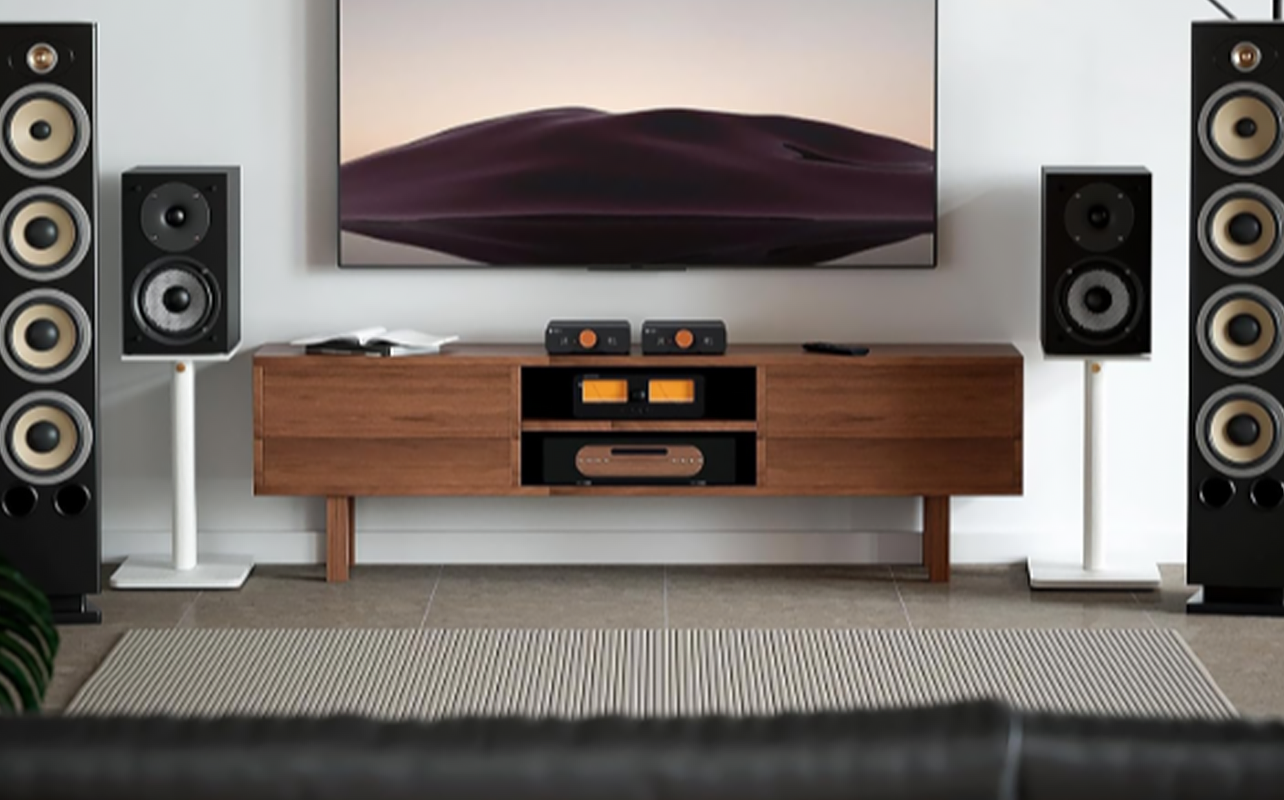
AV receivers often work especially well in larger home theatre spaces because they support multiple speaker channels and surround sound configurations. A receiver with higher channel counts, strong power output, and surround sound processing can help distribute sound evenly across the room. Pairing a 7.1- or 9.2-channel receiver with tower speakers, centre channel speakers, surround speakers, and a subwoofer can create a theatre-like experience with powerful, room-filling audio.
Many AV receivers also include advanced room calibration systems that automatically adjust audio settings based on your room layout and speaker placement. These systems can optimize dialogue clarity, bass response, speaker timing, and surround sound effects without requiring complicated manual adjustments.
Speaker placement matters too
Speaker placement is another important factor when building a home audio system. Front speakers are typically positioned on either side of the TV, while centre channel speakers are placed above or below the screen to anchor dialogue to the picture. Surround speakers are usually positioned beside or behind the listening area to create immersive environmental effects, while subwoofers often perform best near the front of the room or in corners depending on the acoustics.
Room acoustics can also significantly affect sound quality. Large open spaces may benefit from rugs, carpets, furniture placement, or acoustic panels to reduce echo and improve overall clarity. Whether you choose a receiver or amplifier, creating a balanced listening environment is just as important as choosing the right equipment.
Wired vs wireless setups
Modern receivers increasingly support wireless streaming features like Bluetooth, Wi-Fi, AirPlay, and multi-room audio playback. These features make it easy to stream playlists from your phone, connect wireless speakers, or access music services quickly without additional hardware. Stereo receivers and AV receivers often include these conveniences, while amplifiers tend to focus more heavily on wired audio performance.
Wired systems, however, still provide the most reliable and consistent performance for full home theatre installations and dedicated stereo listening setups.
Future-proofing your system
Future-proofing is another major advantage of AV receivers. Many modern models support advanced features like 4K video passthrough, HDR formats, 8K compatibility, VRR (Variable Refresh Rate), and HDMI eARC. These features are especially important for gamers using newer consoles and for users planning future TV upgrades.
An AV receiver also provides more flexibility as your setup evolves over time. You might start with a simple 3.1-channel system and later expand into a full 5.1, 7.1, or Dolby Atmos surround sound configuration as your home theatre grows.
Frequently asked questions
Who should buy a receiver?
A receiver is usually the best choice for users who want an all-in-one audio solution with built-in amplification, source switching, and multiple connectivity options. Stereo receivers are ideal for users focused mainly on music listening and two-speaker setups, while AV receivers are better suited for surround sound home theatre systems with TVs, gaming consoles, streaming devices, and multiple speakers.
If you regularly watch movies, play games, stream music, or want simplified control over several devices at once, a receiver can provide the flexibility and convenience needed to manage your setup more easily.
Who should buy an amplifier?
An amplifier is often the better option for listeners who primarily care about music performance and stereo sound quality. If you prefer a simpler setup with two speakers, listen to vinyl records, or want focused audio reproduction without the added complexity of surround sound processing, an amplifier can provide a cleaner and more streamlined listening experience.
Amplifiers are also a strong choice for smaller spaces or users who don’t need extensive HDMI connectivity or multiple speaker channels. A good integrated amplifier paired with quality stereo speakers can deliver impressive sound for music, TV, and casual listening.
Is a stereo receiver the same as an amplifier?
Not exactly. A stereo receiver includes an amplifier, but it also adds extra features like source switching, built-in radio tuners, and sometimes wireless streaming connectivity. An amplifier focuses mainly on boosting audio signals and powering speakers. A stereo receiver combines amplification with additional controls and features for easier system management.
Is an AV receiver better than a stereo receiver?
It depends on your setup and listening habits. A stereo receiver is often better suited for traditional two-channel music listening. An AV receiver, on the other hand, is designed for surround sound home theatre systems. If you like movies, gaming, and immersive audio formats like Dolby Atmos, an AV receiver is usually the better choice. If you mainly listen to music with two speakers, a stereo receiver may be all you need.
Can you use an AV receiver and amplifier together?
Yes, some advanced home theatre systems combine receivers and amplifiers together. In these setups, the AV receiver may handle surround sound processing, device management, and video switching. An external amplifier powers specific speakers, such as the front left and right channels.
This approach allows users to combine the immersive surround sound benefits of a receiver with the refined stereo performance of a dedicated amplifier. While it’s more common in enthusiast-level systems, it shows that receivers and amplifiers don’t always compete directly and can sometimes complement each other.
Do you need an AV receiver if you already have a sound bar?
Not necessarily. Many sound bars already include built-in amplification and surround sound processing. They’re a simpler alternative to a traditional AV receiver setup. However, AV receivers offer more flexibility, better upgrade potential, and support for larger multi-speaker systems. If you eventually want a more immersive home theatre experience with separate speakers and advanced surround sound formats, an AV receiver may still be worth considering.
Can a receiver improve TV sound quality?
Yes. Even a basic receiver paired with quality speakers can dramatically improve TV audio compared to built-in TV speakers. Receivers provide more power, better speaker separation, clearer dialogue, and deeper bass. They help movies, sports, and streaming content sound fuller and more immersive.

This article was drafted using AI technology and then reviewed, fact-checked, and revised by a member of our editorial team.





I had no idea AV receivers can auto-calibrate with a microphone-that’s genius for my weird living room shape