
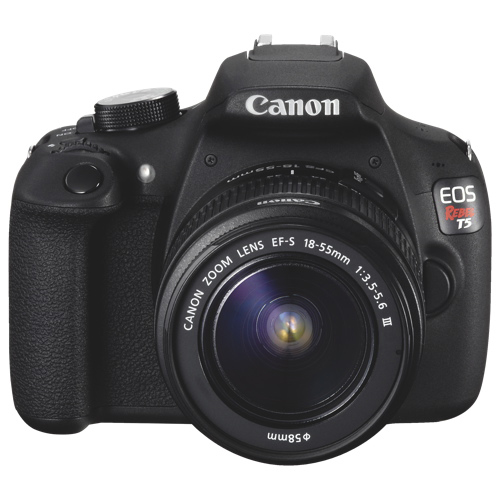
 If you were to judge by the names alone, you might assume that the Canon Rebel T5 and the Rebel T5i are pretty similar cameras. And indeed on first glance they do appear so, but look a little bit closer and you’ll see some pretty interesting differences.
First let’s talk about the T5. This is the latest entry-level DSLR by Canon, and carries an 18MP APS-C sized sensor. It comes with a viewfinder and a nice big 3 inch LCD screen, either of which can be used to compose images. It shoots HD video, but only with mono audio. It comes with a pop-up flash but also has a hotshoe so you can mount a speedlight.
As you would expect from a DSLR you can shoot in fully manual mode, where you can control the aperture and shutter speed (see this post to learn more about manual controls). If you’re familiar with ISO you’ll know that this is another variable in the exposure equation, but the T5 allows you to set it to Auto, whereby the camera will choose the ISO for you, which is a handy feature that older cameras lack.
The T5 also comes with shutter priority mode, aperture priority mode (my preferred mode), and program mode, as well as 8 different automatic modes. Some of these are intended for specific situations like portraits or action shots, but you also get ‘Scene Intelligent Auto’ mode which assesses the scene and selects the most appropriate settings. It does seem a little bit odd that Canon still includes all the other automatic modes if ‘Scene Intelligent Auto’ really is that intelligent.
It’s a really lightweight and manageable camera – in fact I find it a little too small for my hands, as my little finger ends up underneath the handgrip instead of around it as it would be on my 5D.
One of the drawbacks of the T5 – and it’s a sign of how far camera technology has come that I would even mention this – is that it is not wifi enabled (nor is the T5i for that matter). The Powershot SX600 which I reviewed last week has wifi functionality, so Canon does have the technology, which makes it omission from the T5 all the more curious.
In my opinion the T5 is a camera for someone who’s interested in learning more about photography, someone who’s already spent some time shooting with a point-and-shoot or a camera phone and wants to push their photography a bit further. To get the most out a DSLR like this you need to move out of the automatic modes. I also think you need to replace the lens that comes with the T5, which really doesn’t do the camera justice. I always advise people to pick up the Canon 50mm f/1.8, which is a really great value lens that will yield much better results.
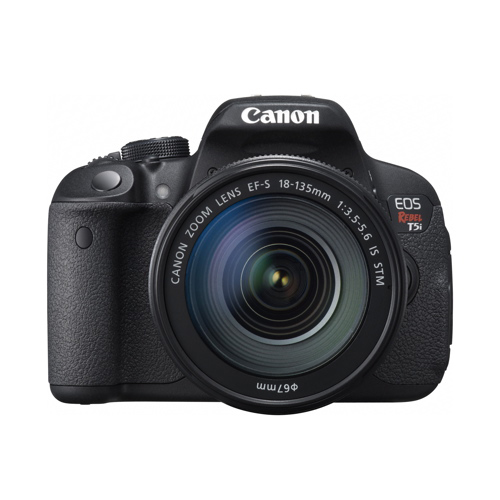 Now, on to the T5i. As I mentioned earlier there are a few significant differences here. In fact I think the naming system that Canon uses is unnecessarily deceptive. Think of ‘T5’ and ‘T5i’ as nicknames. The real names for these cameras are the 1200D and the 700D. The rule of thumb with Canon cameras is that the smaller the number the better the camera. Hence the professional models are the 5D and the top-of-the-range 1D.
So as you can surmise from the numbering, you do get quite a bit more with the T5i. One of the big features is the pop-out LCD screen, which you can twist and swivel to your hearts content. It’s also touch-enabled, which means you can work through all the menus simply by tapping the screen. You do have to press the ‘Menu’ button to get to the main menu, but once you’re in there it’s tap, tap, tap. You also have to use the mode selection dial to change modes, and if you want to shoot video the on/off switch has a third option which puts you into video mode. This is nice little shortcut – on the T5 the video mode is accessed via the mode dial.
You can actually control all your manual shooting controls via the touchscreen too, including aperture, shutter speed, ISO, white balance, metering mode – the full monty basically. And here’s the real kicker: if you switch to live preview mode, where you’re composing your image via the screen instead of the viewfinder, you can actually tap to focus and shoot simultaneously. Now that’s cool.
When you’re reviewing your images in playback mode, you can use the touchscreen to swipe left or right, and also use your fingers to zoom in on the image, or pinch your fingers to see multiple images instead of just one. You can’t delete images using the touchscreen though, which is a feature I would personally like.
The T5i comes with an EFS 18-135mm lens with image stabilisation. To my mind this is a much better lens than the 18-55mm that comes with the T5, both in terms of the build quality and image quality. The ‘S’ in ‘EFS’ refers to the STM (Stepper Motor) which drives the autofocus, and does so silently, which is an important feature for recording video.
This brings us nicely to the T5i’s major strong point – shooting video. Along with silent autofocus and image stabilisation you get stereo audio recording (the T5 is mono only) and the ability to plug in an external mic (not possible with the T5). But the feature that really stands out is the touchscreen autofocus, which allows you to smoothly (and silently) change your point of focus while shooting.
With the T5i you basically have the ability to shoot amazing home movies, or even an independent film or documentary. This is powerful technology in a really compact package that totally levels out the playing field for potential filmmakers. If you’ve got an idea for a film, this camera basically takes care of the technology, freeing you to focus on everything else.



I am in film school and have been looking for a good camera for projects and my own films.
So far the only advantages i see for the T5i is the sound (unless you use a boom and a separate recorder, sound will be crap on any camera) and the auto focus which I feel manual is better anyhow.
I have a question with a sutable housing would thr canon t5 be sutable for underwater photography
I see no reason why not. The only thing is, underwater housing’s can be really expensive.
Another option would be to look at the Nikon AW1 which is waterproof to a depth of 49 feet. The downside is that it has a smaller sensor than the T5, so you wouldn’t be abl to make prints as large as with a T5, and also the high ISO (low light) performance won’t be as good. On the upside, with the AW1 you can shoot at a blazingly fast 15 frames per second!
Speaking of underwater photography, I was just looking at a project by Australian photographer Trent Parke called ‘The Seventh Wave’ which has some amazing underwater shots, you can check it out here.
It may be simplier to get a GoPro for your water footage.
Warning, you loose light very easily if you go too deep. Colors change 10 to 60 feet deep.
GoPro is another option, but they’re moreso video cameras than a photography cameras.
You can check out Best Buy’s entire waterproof selection here.
Hi, I was just curious what the difference from the audio in both are. I read the T5 is mono audio… I’m just not sure what that means vs the T5i’s stereo audio recording.
Thanks for all of the useful info!
To add-on to my first comment, I’m mainly wanting a nice camera to take pictures and videos of my son once he’s born and while growing up. Would you said the T5 would suffice for that vs spending more for the T5i?
Mono means there is ONE microphone. Stereo means there is TWO microphones. When possible always strive for the stereo option as it adds to the realism. When the child starts screaming…. it will be like you were there! It’s like 3D for your ears!
Videos? Do you plan to be using auto-focus? If you are not planning to get STM lenses (not all models support them), turn up your computer speakers and listen to this famous Canon video!
https://www.youtube.com/watch?v=9r3VcFueYw4&t=4s
Hi Molly,
I always advise people to get the best camera that your budget will allow, and the T5i does have some nice features that the T5 doesn’t have.
Another camera you might like to consider is the Olympus OM-D EM-10. It shoots HD video with stereo sound, has a pop out screen like the T5i and is wi-fi enabled (unlike the T5i) which means you can share photos of your son with ease. It has a touchscreen too. But one of the most impressive features is the image stabilisation which will give you much smoother videos.
Best Buy has a pretty amazing deal on the EM-10 right now, which basically means you get a free lens:
http://www.bestbuy.ca/en-CA/product/-/b0004244.aspx?path=c51e3d23626ac1962f8b280215f51e1aen02
Please research before making assertive comments. For example, you said in your post that the “S’ in EFS (Canon EFS lenses) stands for stepper motor. The “S” in EFS does NOT stand for stepper motor. The “S” in EFS means short-back focus. The STM designation is for a lens with a stepper motor for focusing, which allows for silent focusing applicable to video.
Thanks for the comment jds! You are right, the ‘S’ in ‘EF-S’ does not stand for ‘STM’. My bad!
Can you turn off Image Stabilzation on either the T5 ot T5i?
Hi alexander1983. As far as I’m aware you turn off image stabilization via a switch on the lens itself.
If I have been using a Canon Powershot IS for the last few years would you reccomend getting the T5 or the T5i? I have had to use the camera soley on manual for the last year or so due to the fact that the camera is very old and auto mode no longer works well. I have gotten very good with using the manual settings, but it is time for a new and better camera, I am just not sure which one. Thanks.
Comments are closed.