

Picking the right tablet comes down to three decisions: which operating system fits how you already work, how big a screen you actually need, and how much processing power you’re willing to pay for. Get those three right and everything else- storage, accessories, connectivity falls into place around them.
For most Canadian shoppers, that means choosing between iPadOS, Android, or Windows first, then deciding whether entry-level power is enough or you need something closer to a laptop replacement. This guide walks through exactly how to make that call, which tablets are worth buying in 2026, and who each one actually suits. If you’re still weighing a tablet against a full laptop before you get this far, our Laptop or Tablet? Choose the Right Device guide breaks that decision down separately.

Table of Contents
- Why choose a tablet or iPad?
- How to choose a tablet or iPad
- What is the best tablet to buy in 2026?
- Who should use a tablet or iPad
- Using Wi-Fi vs data on your tablet or iPad
- What accessories to get for a tablet or iPad
Why a tablet or iPad?
A tablet or iPad gives you the convenience of a smartphone with a larger screen, plus many of the capabilities of a laptop, without the size or weight of one. You can stream, browse, read, game, video call, take notes, manage email, edit photos and video, draw, and build presentations. Add a keyboard for laptop-style typing, or a stylus for handwriting and sketching, and a tablet starts covering a surprising amount of daily work.
The honest tradeoff: a tablet isn’t a full laptop replacement for everyone. If your job lives in spreadsheets with dozens of open tabs, or you need specific desktop software, a laptop still does that better. But for content consumption, note-taking, casual creative work, and light-to-moderate productivity, a tablet is often lighter, has better battery life, and is more comfortable to use on a couch, plane, or coffee shop table than a laptop ever will be. You can browse the full lineup of tablets and iPads at Best Buy Canada once you’ve narrowed down what you need.
How to choose a tablet or iPad
Choosing the right tablet starts with how you plan to use it, not with specs. Work through these decisions in order.
Choose your operating system
iPadOS is the natural fit if you already use an iPhone, Mac, or Apple Watch; your files, messages, and photos sync automatically across devices. Android tablets offer far more variety in brand, design, and price, and pair well with Android phones and Windows PCs. Windows tablets are the right call specifically when you need traditional desktop software, Adobe Creative Cloud, full Microsoft 365, or line-of-business apps that don’t have a mobile version.
The tradeoff across all three is worth knowing upfront. Apple’s ecosystem is the most polished, but it’s also the most closed. It’s typically the most expensive at a given performance tier, too. Android is the most flexible and often the best value. That said, app quality and software update timelines vary much more by brand than they do with Apple. Windows gives you real desktop compatibility. The cost is battery life and weight compared to a similarly priced iPad or Android tablet.
Pick the right screen size
Compact tablets (around 8 inches) are easiest to hold one-handed and travel well. 11-inch models are the sweet spot for most people, with enough room for split-screen multitasking without becoming awkward to carry. Larger 12- to 14.6-inch tablets suit drawing, document-heavy work, and multitasking, but they’re noticeably less comfortable to hold for long stretches without a stand or keyboard case.
Consider the display
Look past resolution alone. Brightness, contrast, colour accuracy, and refresh rate all shape how the screen actually feels day to day. OLED and AMOLED panels deliver deeper blacks and stronger contrast than LCD, which matters for video and photo work. A 120Hz refresh rate makes scrolling, handwriting, and compatible games noticeably smoother than the 60Hz standard.
Choose enough processing power
A basic tablet handles browsing, streaming, email, and schoolwork without issue. A more powerful chip matters for gaming, photo and video editing, and heavy multitasking. Current premium tablets also include dedicated AI hardware; Apple Intelligence, Galaxy AI, and Copilot+ features all rely on an on-device neural processor, so if those features matter to you, check for one specifically rather than assuming any recent chip includes it.
Get enough storage
128GB is a reasonable starting point for everyday use. 256GB suits anyone downloading games, media, or working with photos regularly. If you shoot or edit large video files, go for 512GB or more. Tablet storage generally isn’t expandable on iPad or Surface, so buy for where you’ll be in two years, not just today.
Decide if you need accessories
A stylus turns a tablet into a digital notebook or drawing canvas. A keyboard makes typing and document work far more comfortable. Neither is universal across models, so confirm compatibility with your exact tablet before buying a stylus or keyboard built for one generation won’t always work with the next.
Choose Wi-Fi or cellular
Wi-Fi-only covers most people fine. A cellular model is worth the extra cost only if you regularly work, travel, or commute somewhere without reliable Wi-Fi.
Consider your ecosystem
Think about what you already own. An iPad pairs its Camera Continuity and Universal Clipboard features with a Mac. A Galaxy Tab’s Auto Switch and Quick Share work best alongside a Galaxy phone. A Surface Pro slots directly into a Windows-based setup with the same file structure and apps as your desktop. Buying outside your existing ecosystem isn’t wrong, but you’ll lose some of the automatic hand-off features that make owning multiple devices from the same brand genuinely convenient.
What is the best tablet to buy in 2026?
The best tablet depends on how you plan to use it, not which one has the highest benchmark score. The iPad Pro suits demanding creative and professional work, the iPad Air balances performance and price, the Galaxy Tab S11 series is the strongest premium Android option, and the Surface Pro is the right call specifically when you need Windows software. Here’s how they break down.
Apple iPad
The iPad Pro is available in 11-inch and 13-inch sizes with Apple’s M5 chip, an Ultra Retina XDR display, ProMotion, Apple Intelligence, and support for Apple Pencil Pro and the Magic Keyboard. It also gets iPadOS 26’s windowed multitasking and support for professional apps. That makes it built for demanding creative and productivity workflows, not for someone who mainly wants to watch Netflix and check email.
The iPad Air runs on Apple’s M4 chip in the same 11-inch and 13-inch sizes, with Apple Intelligence, Apple Pencil Pro support, and Wi-Fi 7. It’s the strongest middle ground in Apple’s lineup. It’s fast enough for nearly everything short of professional video editing, at a meaningfully lower price than the Pro.
The standard iPad uses the A16 chip with an 11-inch Liquid Retina display and starts at 128GB. It’s aimed squarely at everyday browsing, streaming, schoolwork, and video calls. The iPad mini runs the A17 Pro chip in an 8.3-inch body and supports Apple Pencil Pro, prioritizing portability over screen real estate.
The tradeoff across the iPad line is straightforward: you’re paying for iPadOS polish and Apple ecosystem integration. The jump from iPad to Air to Pro is mostly about how much multitasking and creative headroom you need, not baseline usability. The entry iPad handles daily tasks fine for most people.
You can compare the full range of Apple tablets at Best Buy Canada.
Android tablets
Several brands build Android tablets, but Samsung’s Galaxy Tab S series leads the premium end. The current Galaxy Tab S11 (11-inch) and Galaxy Tab S11 Ultra (14.6-inch) both use MediaTek’s Dimensity 9400+ processor with Dynamic AMOLED 2X displays at up to 120Hz. The Ultra’s massive screen suits multitasking and creative work; the standard S11 is easier to carry day to day.
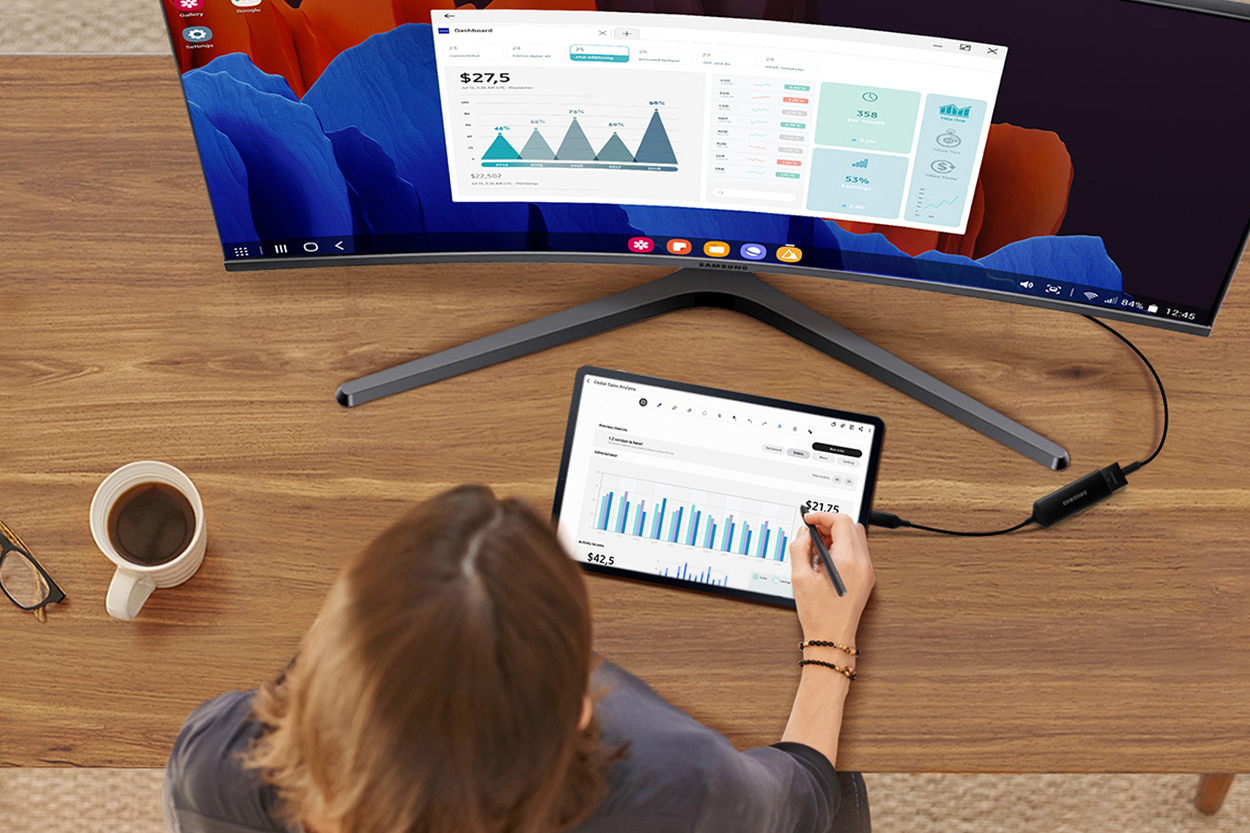
Samsung’s ecosystem features add real value here. Auto Switch lets compatible Galaxy devices hand off tasks seamlessly. Samsung DeX turns the tablet into a desktop-style interface, with an Extended Mode on the S11 series for working across the tablet and an external monitor. Both models include an S Pen in the box, so you’re not paying extra for stylus support the way you would with most other brands. Galaxy AI features support writing, drawing, and audio summarization on-device.
The tradeoff with Android tablets generally, Samsung included, is app optimization. Android’s tablet app selection has improved significantly, but it still isn’t as consistently tablet-tailored as iPadOS, particularly for niche creative and productivity apps.
Browse the full range of Android tablets at Best Buy Canada.
Windows tablets
Microsoft has built genuine tablet hardware around Windows 11 for years, and the Surface Pro remains the clearest example. It’s now available in two generations side by side: a 12-inch model with an 8-core Snapdragon X Plus processor and a 90Hz LCD touchscreen, and a newer 13-inch Surface Pro (12th Edition) with Snapdragon X2 Plus or X2 Elite processors and a 120Hz LCD or OLED display.
Models with Snapdragon processors include a dedicated NPU for on-device AI and Copilot+ features, and are built around Windows 11’s full PC-style software environment, the single biggest reason to choose a Windows tablet over an iPad or Android tablet. You get the same desktop applications and workflows available on a Windows laptop, not a mobile-scaled version. Optional keyboards and the Surface Slim Pen let you switch between laptop-style typing and tablet-style touch and pen input.
The tradeoff: even with an efficient ARM chip, a Surface Pro won’t match an iPad’s battery life or slim profile, because it’s running a full desktop operating system rather than a mobile one built for tablets from the ground up. If you don’t specifically need Windows software, that tradeoff usually isn’t worth it.
See the full lineup of Windows tablets at Best Buy Canada.
Affordable and value tablets
A premium tablet isn’t necessary for everyone. If your needs are modest browsing, streaming, schoolwork, casual gaming, a more affordable option delivers real value without the top-tier specs.
Budget-friendly iPads
The standard iPad (A16) is Apple’s own affordable option, with 128GB of storage as a starting point. An older-generation iPad Air or iPad Pro from a reputable retailer can also be worth it at a discount, provided it still supports the apps and features you need.
Lenovo’s Android value lineup
On Android, Lenovo covers the value and mid-range space well through its Lenovo Tab, Idea Tab, and Legion Tab families. The Idea Tab Pro offers a 12.7-inch 3K display and comes with a Tab Pen Plus, making it a strong all-rounder for students. The Legion Tab line targets gaming specifically, pairing a high refresh-rate display with vapour chamber cooling. Pay close attention to the exact model and configuration; screen size, storage, and included accessories vary a lot within Lenovo’s own lineup.
Amazon Fire tablets
Amazon Fire tablets round out the budget end. They’re not built for high-end specs, but the Fire HD line is genuinely fine for streaming, reading, and browsing, and Fire HD Kids models add a protective case and parental controls for younger users.
For any value tablet, check the software experience as carefully as the hardware app availability, update support, and accessory compatibility often matter more day to day than a slightly faster processor.
If you’re shopping by price point specifically rather than by brand, The Best Tablets for Every Budget and Need breaks options down that way in more detail.
| Tablet | Best for | Key highlights |
|---|---|---|
| Apple iPad Pro (11″ / 13″) | Creative professionals, power users | M5 chip, Ultra Retina XDR display, Apple Intelligence, Apple Pencil Pro and Magic Keyboard support |
| Apple iPad Air (11″ / 13″) | Everyday productivity, students | M4 chip, Apple Intelligence, Apple Pencil Pro support, strong price-to-performance balance |
| Apple iPad (11″) | Everyday use, entertainment, families | A16 chip, 128GB starting storage, ideal for browsing, streaming, and schoolwork |
| Apple iPad mini (8.3″) | Travel, reading, portability | Compact design, A17 Pro chip, Apple Pencil Pro support |
| Samsung Galaxy Tab S11 | Premium Android users | Dimensity 9400+, S Pen included, Galaxy AI, DeX productivity mode |
| Samsung Galaxy Tab S11 Ultra | Multitasking, creative work, entertainment | 14.6″ AMOLED display, S Pen included, DeX Extended Mode |
| Microsoft Surface Pro (12″ / 13″) | Windows users and professionals | Full Windows 11, Snapdragon X/X2 options, AI-powered NPU, optional keyboard and Slim Pen |
Who should use a tablet or iPad
Tablets sit between smartphones and laptops in size and capability, which is exactly why they suit such a wide range of people.
Students and creative users
Students can use a tablet for note-taking, research, reading textbooks, and watching lectures, adding a keyboard for longer writing sessions or a stylus for handwritten notes. Creative users get a portable canvas for drawing, photo and video editing, and music creation; a higher-performance tablet with strong stylus support matters most here.
Professionals, travellers, and families
Professionals and remote workers can handle email, video calls, and document editing comfortably, especially with a keyboard and trackpad attached. Travellers and commuters benefit from a larger screen than a phone without a laptop’s bulk, with downloaded content or a cellular model covering time away from Wi-Fi. Families get an easy shared device for entertainment and educational apps, look for parental controls if children will use it.
Seniors, casual users, and gamers
Seniors and casual users often find the larger screen and simpler interface more comfortable than a smartphone for browsing, calls, and photos. Gamers should prioritize a fast processor, high refresh rate, and good speakers.
If you want a deeper breakdown by exactly what you’ll use the tablet for, Best Tablets by Use Case goes persona by persona in more detail, including note-taking-specific picks if that’s your main use case.
Using Wi-Fi vs data on your tablet or iPad
Staying connected is one of the biggest advantages of owning a tablet or iPad. That’s true whether you’re streaming content at home, working on the go, or travelling between destinations. Most tablets connect through Wi‑Fi. Some models also offer cellular connectivity through 5G or 4G LTE. This lets you access the internet when a wireless network isn’t available.
Understanding the difference between Wi‑Fi and cellular data can help you choose the right model for your needs. It’s also worth knowing how newer wireless technologies like Wi‑Fi 6, Wi‑Fi 6E, and Wi‑Fi 7 can improve speed, reliability, and overall performance depending on the device and network you’re using.
Wi-Fi 6 and Wi-Fi 7
Wi-Fi 6 remains more than capable for everyday tablet use, including 4K streaming. The newer Wi-Fi 7 standard offers higher theoretical throughput and better reliability, but only when your tablet, router, and network all support it. Buying a Wi-Fi 7 tablet without a Wi-Fi 7 router won’t get you the benefit. It’s already standard on several premium models, including the iPad Pro (M5), the iPad Air (M4), the Galaxy Tab S11 Ultra, and the Surface Pro 13-inch (12th Edition).
5G and 4G LTE
Cellular tablets connect to the internet independent of Wi-Fi. This is useful if you regularly travel, commute, or work somewhere without reliable networks. Canadian carriers including Rogers, Bell, and Telus offer data-only plans built specifically for tablets. Some are available without a long-term contract. Before paying extra for a cellular model, check your actual usage pattern. If you’re mostly on Wi-Fi at home, school, or work, a Wi-Fi-only model saves money without costing much convenience. Current iPad cellular models use eSIM rather than a physical SIM card. Confirm your carrier supports eSIM before buying.
What accessories to get for a tablet or iPad
1. Stylus
A stylus turns your tablet into a notepad or drawing canvas. It’s useful for anything from quick handwritten notes to detailed illustration work. Not every tablet includes one, and compatibility isn’t universal. A Samsung S Pen won’t work with an iPad, for instance. Apple Pencil compatibility also varies by both iPad model and Pencil generation. Always confirm the exact match before buying.
2. Tablet case
A case protects against everyday drops and scratches, in folio, rugged, or slim styles depending on your priorities. Check the exact model before buying, since even tablets within the same product family can differ in dimensions and port placement between generations.
3. Keyboard
Attaching a keyboard turns a tablet into something closer to a laptop, particularly useful for long documents or spreadsheet work. Some are Bluetooth, others use magnetic connectors specific to one manufacturer’s tablets, such as Apple’s Magic Keyboard or Microsoft’s Surface Pro Keyboard. Check whether the one you’re considering includes a trackpad and backlighting before deciding it’s worth the cost.
4. Screen protector
A screen protector guards against scratches and reduces fingerprint smudging without noticeably affecting brightness or stylus response. A matte, paper-like protector also cuts glare and adds a bit of handwriting friction, at a slight cost to perceived sharpness.
5. Tablet stand
A stand frees up your hands for video calls, recipes, or working at a desk, and some tablets support genuine second-screen functionality with a compatible computer Samsung with select Windows PCs, and Apple’s Sidecar with compatible Macs. Confirm software compatibility before assuming your tablet can double as a monitor.
6. Battery pack
An external battery pack extends a long day away from an outlet. Because tablets have larger batteries than phones, not every pack can fully recharge one; check both capacity and charging wattage, and match your tablet’s supported charging standard, since a fast power bank won’t charge every tablet at its full rated speed.
Finding the right fit
The tablet that’s “best” isn’t the one with the highest specs on paper; it’s the one whose operating system already fits into how you live and work, sized and powered for what you’ll actually use it for day to day. That’s the whole decision, really: match the ecosystem first, then let screen size and performance follow from there.
Once you’ve got a shortlist in mind, tablets and iPads at Best Buy Canada are a good place to see what’s actually in stock and start comparing.
Frequently asked questions
iPads run iPadOS and integrate closely with Apple devices. Android tablets, from brands like Samsung and Lenovo, run Google’s OS and offer more variety in size, design, and price.
The standard iPad handles everyday schoolwork. The iPad Air suits creative apps and heavier coursework, while the iPad Pro fits creative fields like design and video production.
An 8-inch tablet is easiest to carry; 11 inches suits most people. Larger 12- to 14.6-inch models are better for multitasking and drawing, but less comfortable to hold.
For content, note-taking, and light productivity, yes, especially with a keyboard. A Surface Pro comes closest since it runs full desktop software; for spreadsheet-heavy work, a laptop is still better.
Wi-Fi covers most needs. Choose cellular only if you regularly work somewhere without reliable Wi-Fi, since it adds hardware and data plan costs.
Often, yes, from a reputable retailer at a genuine discount. Just confirm the model still supports current apps and software updates.
The iPad Air or Pro with Apple Pencil Pro, or a Galaxy Tab S11 with its included S Pen, are the strongest choices for natural handwriting feel and app support.

This article was drafted using AI technology and then reviewed, fact-checked, and revised by a member of our editorial team.





Games I played on fb are leaving the pc platform. (golf etc.) Need an android device, not a fan of apple & I’ve never had a cell phone
Hi , I am looking for a table with keyboard and pen to allow me to create interactive learning resources, with photos, videos, dictionary (link to external websites) and annotations. I am looking for the best value for money product. What would you recommend? Thank you!Andreea
I bought a Samsung tablet 10 in for 199. and it lasted for two years, I loved my tablet and it could not be fixed which disappointed me now I am real hesitant to buy another Samsung tablet but I want one can you suggest a good tablet that will last longer than two years
What is the best I-pad or tablet for gaming ????
Hi Mildred,
I will send your question to the gaming team but first I’d like to know what type of gaming are you looking to do on a tablet. Some games are more demanding, and therefore require a more powerful (and likely more expensive) device, than others. If you can give us more specific details about how you want to use the tablet we will be able to give you suggestions that will be more helpful for you.
thank you,
Martin